
The rapid and accurate identification of bacterial pathogens and determination of their antimicrobial susceptibility are fundamental components of modern clinical microbiology. Bacterial identification provides essential information about the causative organism, while antimicrobial susceptibility testing (AST) determines which antimicrobial agents are likely to be effective against the identified pathogen. These processes form the basis of the antibiogram, an important laboratory and epidemiological tool used to guide antimicrobial therapy, monitor antimicrobial resistance (AMR), and support infection prevention and control. With the increasing global burden of antimicrobial resistance, there is a growing need for diagnostic approaches that are rapid, reliable, reproducible, and capable of processing large numbers of clinical isolates efficiently.
Traditional bacterial identification relies on phenotypic and biochemical techniques, including colony morphology, Gram staining, biochemical reactions, and manual antimicrobial susceptibility testing. Although these methods remain valuable, they can be labour-intensive and may require several hours or days to produce definitive results. Variations in interpretation and the limited discriminatory capacity of some conventional tests can also affect the accuracy and reproducibility of bacterial identification. These limitations have encouraged the development and adoption of automated and semi-automated technologies in clinical microbiology laboratories.
Automated bacterial identification and antibiogram systems integrate multiple analytical procedures to provide standardized identification and antimicrobial susceptibility results. Depending on the platform, bacterial identification may be based on biochemical profiles, metabolic characteristics, or protein fingerprints. Examples include automated biochemical identification systems, VITEK Automated compact systems, and Matrix-Assisted Laser Desorption/Ionization–Time of Flight mass spectrometry (MALDI-TOF MS). MALDI-TOF MS has substantially improved the speed of bacterial identification by generating characteristic protein spectra from bacterial isolates and comparing them with reference databases. In many laboratory settings, reliable identification can be obtained within minutes once a suitable bacterial colony is available.
Automated antimicrobial susceptibility testing systems complement bacterial identification by evaluating the response of isolates to a range of antimicrobial agents. Results may be expressed as minimum inhibitory concentrations (MICs) or interpreted categorically as susceptible, intermediate, or resistant according to established clinical breakpoints. These data contribute directly to the development of patient-specific antibiograms and, when aggregated over time, to cumulative antibiograms that describe local antimicrobial resistance patterns. Such information is valuable for empirical antimicrobial selection, antimicrobial stewardship programmes, surveillance of emerging resistance, and infection-control strategies.
Despite their advantages, automated systems require appropriate quality control, standardized procedures, validated databases, and trained laboratory personnel. Their performance may vary according to bacterial species, specimen type, antimicrobial agent, resistance mechanism, and the characteristics of the analytical database. Certain resistance mechanisms may also require additional confirmatory testing when automated results are uncertain or when clinically important resistance phenotypes are suspected.
Automated systems have transformed bacterial identification and antimicrobial susceptibility testing by improving analytical speed, standardization, and laboratory efficiency. Their integration into routine microbiological workflows enables laboratories to generate clinically relevant information more rapidly while contributing to antimicrobial resistance surveillance and evidence-based antimicrobial therapy.
VITEK 2 Automated Compact System
There are several commercially available automated systems or computerized instruments and/or equipments that aid in the clinical/laboratory diagnosis of infectious diseases in the hospital especially as it relates to prompt and accurate identification of microbes. These automated systems also aid in carrying out antimicrobial susceptibility test (antibiogram) on identified clinical pathogens so that antimicrobial therapy can be properly guided.
The VITEK 2 automated compact system (BioMérieux-Vitek) is one of such advanced expert systems that could be used in clinical microbiology laboratories for the prompt identification of microbial pathogens and for the determination of the antimicrobial susceptibility of already identified microbes (inclusive of bacteria and fungi). The VITEK 2 automated system is an automated high-throughput microbial identification system that uses an innovative mass spectrometry (MS) technology to provide pathogen identification results and antimicrobial susceptibility test (AST) results in minutes.
The VITEK 2 automated system is a high-throughput platform for microbial identification and antimicrobial susceptibility testing (AST). It uses miniaturized biochemical reactions and automated optical detection to monitor changes in microbial metabolic activity and growth. The system provides standardized and rapid results, thereby supporting the diagnosis of bacterial infections, antimicrobial therapy, and antimicrobial resistance surveillance. Depending on the identification card used, reactions may be detected through fluorescence- or colorimetric-based methods. The system enables the rapid identification of clinically relevant microorganisms, including Gram-negative bacteria, Gram-positive bacteria, and yeasts, generally within a few hours following isolation and preparation of the microorganism.
For antimicrobial susceptibility testing, the VITEK 2 system monitors microbial growth in the presence of different concentrations of antimicrobial agents and uses these growth patterns to determine the minimum inhibitory concentration (MIC) or an equivalent susceptibility result. The system’s algorithms interpret the generated data using validated antimicrobial susceptibility and microbial identification databases, allowing isolates to be categorized according to established susceptibility criteria. By integrating automated organism identification with AST, VITEK 2 facilitates the generation of standardized and reproducible results that can support clinical antimicrobial selection, antimicrobial stewardship, and surveillance of antimicrobial resistance.
The VITEK system includes an Advanced Expert System (AES) that analyzes minimum inhibitory concentration (MIC) patterns of antimicrobial agents or antibiotics; and this automated system also detects phenotypes for most microbial organisms including Gram positive bacteria, Gram negative bacteria and yeast-like organisms (Figure 1). The VITEK systems provide rapid laboratory test results especially as it is related to bacterial identification and antibiogram. Rapid laboratory results allow clinicians/physicians to discontinue blind treatment or empiric antimicrobial therapy (which allow resistant pathogens to evolve and spread), and thus prescribe targeted antimicrobial therapy that would result into improved patient outcomes and enhanced antibiotic stewardship in this era of skyrocketing antibiotic resistance.
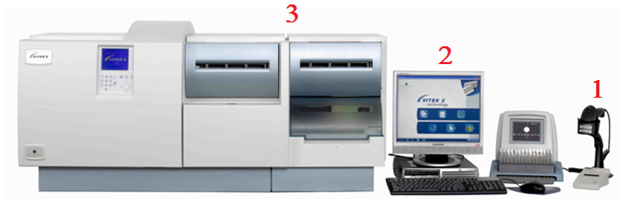
On a daily basis, medical doctors use results from the identification of pathogens from clinical specimens and AST results to determine the antibiotic treatment that is most appropriate for a particular patient or disease in order to achieve best patient care. Also, the results from the AST are used to monitor changes in bacterial resistance to antibiotics in order to detect and halt any possible outbreak of disease due to resistant pathogens. Bacterial identification and antibiotic susceptibility testing play an essential role in patient care and the control of antibiotic resistance.
These important laboratory procedures indicate the aetiology of the disease and also the likely antibiotics most suitable to cure or treat the infection or disease. AST also help physicians to avoid the unnecessary prescription of antibiotics – which help to reduce healthcare costs and prevent the evolution of drug resistant organisms. However, these important clinical microbiology procedures (i.e. identification of pathogenic organisms and AST) are usually delayed in some hospitals because they lack the equipments and or instruments required to carry out these techniques promptly and deliver accurate results under the shortest possible time.
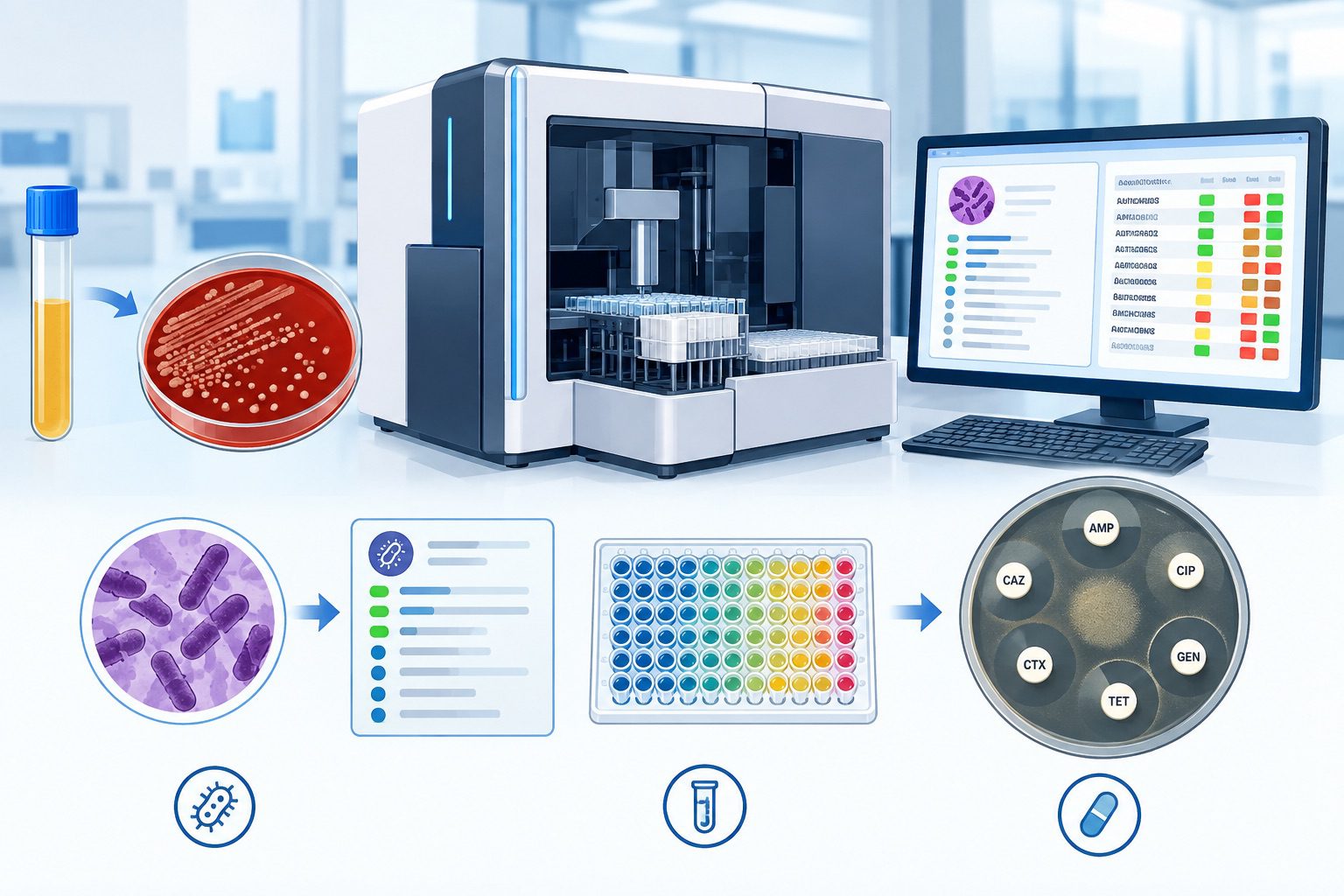
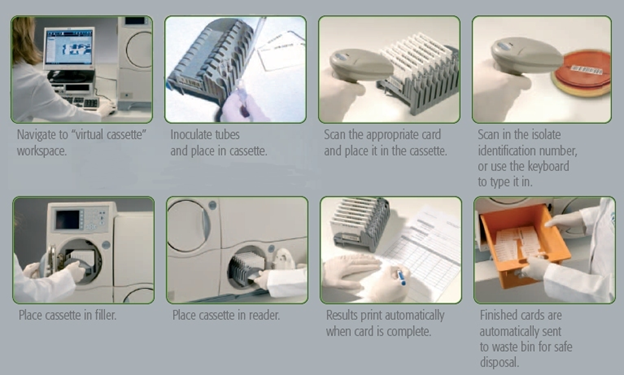
The VITEK 2 system or platform is an AES that offers automated bacterial identification and AST so that clinical results as it pertains to AST and bacterial identification could be obtained within minutes or hours of processing the sample (Figure 2). In the conventional microbiological culture technique of bacterial identification and AST, clinical results pertaining to microbial identification and AST usually takes days to get; and this impact negatively on the patient’s prognosis since blind treatment may be initiated until the test results from the clinical microbiology laboratory is finally obtained.
Each VITEK 2 identification card has several rows of wells comprising of 8 rows of 8 wells that is made up of 64 wells per card (8 wells X 8 wells = 64 wells). The wells of the identification card contain different dehydrated media required for different biochemical tests targeted at identifying via biochemical reactions different microbial strains. These individual biochemical tests are meant for the identification of Gram negative bacteria, Gram positive bacteria and fungi (yeast cells). A capillary tube (which sucks the suspension of bacteria to be identified and dispenses into all the wells) is fixed to each VITEK 2 identification card.
Microbial (bacterial or fungal) growth is spurred by the hydration of the dehydrated media in the in the card with a suspension liquid (e.g. distilled water). The cards are incubated in the card reader / incubation chamber of the VITEK 2 compact system; and the colour changes in all the wells are recorded automatically in the VITEK 2 compact system. The results of the color changes go to a computer system that is attached to the VITEK 2 compact system. The computer system has an inbuilt updated database of different bacterial and fungal organisms as per their unique biochemical reactions. The computer automatically compares the results with those available in its library for different bacteria and/or fungi, and finally gives the name of the bacteria with a definite probability.
For identification of the organism, the given bacterium or fungal organism, grown as isolated colony on a culture media plate or as pure culture grown on a slant are taken; and a loopful of the bacteria is transferred aseptically into sterile saline solution in a test tube and a suspension of the organism is made. The suspension should contain a prescribed density of bacteria, as determined by a densitometer. The test tube is fixed to the cassette and a card is fixed near it, such that the tip of the suction capillary tube of the card remains deeply submerged in the suspension. The number of test tubes and cards fixed to each of the cassette can be increased depending on the number of bacteria or fungi to be identified by the VITEK 2 identification cards. The cassette is put in the vacuum chamber of the system as shown in the illustration.
A high vacuum is created inside the chamber, which forces the bacteria suspension to be sucked into the capillary tubes and dispensed into the wells of the cards. The cassette is taken out and put inside the incubation and analysis chamber where the capillary tubes are cut and the cut ends sealed automatically. The incubation process is allowed to run at a prescribed temperature for a prescribed period of time, which is programmed by the control panel on the VITEK 2 compact system. During incubation, which is usually in every 15 minutes, each VITEK 2 identification card automatically goes to the colour reader, which reads the colour changes in the wells and records them. The recorded results go to the computer, which automatically compares them with those, available in its library for different bacteria. Finally, it gives the names of the bacteria with definite probabilities. The used cards fall into the waste disposal chamber (waste collection bin) of the system for removal and final disposal after sterilization.
Principle and workflow of MALDI-TOF for bacterial identification
Matrix-Assisted Laser Desorption/Ionization–Time of Flight (MALDI-TOF) mass spectrometry is a rapid and increasingly important analytical technique used for the identification of microorganisms, particularly bacteria, in clinical and microbiological laboratories. MALDI-TOF refers to a mass spectrometric method in which microbial molecules, predominantly abundant cellular proteins such as ribosomal proteins, are ionized using a laser in the presence of a chemical matrix and subsequently separated according to their mass-to-charge ratio (m/z). The resulting protein profile, or mass spectrum, functions as a characteristic molecular fingerprint of the microorganism and can be compared with reference spectra contained in a validated database to determine its taxonomic identity. In routine microbiology, MALDI-TOF has substantially accelerated bacterial identification compared with conventional biochemical and phenotypic methods.
The fundamental principle of MALDI-TOF involves three major processes: matrix-assisted ionization, time-of-flight separation, and spectral analysis. Following preparation of a bacterial isolate, a small amount of the microbial material is transferred onto a designated target plate and covered with an appropriate matrix solution. The matrix absorbs energy from a laser pulse and facilitates the desorption and ionization of bacterial molecules while minimizing their fragmentation. The generated ions are accelerated through an electric field into a vacuum flight tube. Because ions with different mass-to-charge ratios travel at different velocities, their time of flight to the detector varies. These differences are measured and converted into a mass spectrum containing a series of peaks representing the molecular composition of the bacterial sample. The resulting spectral pattern is highly reproducible under standardized conditions and can therefore be used for microbial identification.
The sample preparation and spectrum-generation stage is particularly important for obtaining reliable identification. In routine applications, colonies are selected from an isolated bacterial culture and applied directly to the MALDI target plate. Depending on the organism and laboratory protocol, a direct smear method may be sufficient, whereas extraction procedures using reagents such as formic acid may be required for organisms that are more difficult to lyse or identify. After application of the matrix, the sample is introduced into the MALDI-TOF instrument, where laser irradiation generates the characteristic protein spectrum. Appropriate quality-control procedures and standardized preparation are essential because variations in culture conditions, sample preparation, or instrument calibration can influence spectral quality and identification performance.
Following spectrum acquisition, the generated bacterial profile is analyzed by specialized software and compared with a reference spectral database containing validated profiles from known microorganisms. The software calculates the degree of similarity between the unknown spectrum and reference spectra and provides a proposed identification, commonly at the genus and species levels. The reliability of the identification depends on spectral quality, database coverage, and the degree of similarity between closely related organisms.
In the context of antibiograms and antimicrobial resistance (AMR), MALDI-TOF is primarily valuable for rapidly establishing the identity of the bacterial isolate, thereby supporting subsequent antimicrobial susceptibility testing (AST). Although conventional MALDI-TOF identification does not, by itself, replace standardized AST methods for determining antimicrobial susceptibility, rapid identification can shorten the time required to characterize a pathogen and guide the selection of appropriate downstream testing. MALDI-TOF represents an important component of modern microbiological workflows, linking rapid bacterial identification with subsequent susceptibility testing and clinical or epidemiological assessment of antimicrobial resistance.
Role of MALDI-TOF in clinical bacterial identification and antibiogram workflows
Rapid and accurate identification of bacterial pathogens is an essential component of clinical microbiology and antimicrobial stewardship. In routine diagnostic laboratories, MALDI-TOF identification can provide species-level identification of bacterial isolates within a relatively short time, following growth of the organism from a clinical specimen. This rapid identification is particularly valuable for clinically important pathogens such as Escherichia coli, Klebsiella pneumoniae, Staphylococcus aureus, Pseudomonas aeruginosa, and Enterococcus species. Compared with conventional biochemical identification approaches, MALDI-TOF can substantially shorten the time required to establish the identity of an isolate, thereby allowing subsequent AST and clinical interpretation to proceed more efficiently.
The identification obtained through MALDI-TOF complements rather than replaces AST. While bacterial identification establishes the organism responsible for an infection, AST determines its susceptibility or resistance to specific antimicrobial agents. The combined information provides a more complete basis for clinical decision-making. For example, identification of a bacterial isolate as K. pneumoniae provides important taxonomic information, while the corresponding antibiogram can indicate whether the isolate is susceptible or resistant to β-lactams, fluoroquinolones, aminoglycosides, carbapenems, or other relevant antimicrobial classes. Consequently, MALDI-TOF contributes to the identification stage of the diagnostic pathway, whereas AST provides the phenotypic susceptibility profile required to guide antimicrobial selection.
The integration of rapid bacterial identification with antibiogram data can also improve laboratory workflow and antimicrobial stewardship. Earlier identification may allow laboratories to prioritize appropriate AST procedures and communicate clinically relevant results to healthcare providers sooner. This is particularly important in severe infections, where delays in appropriate antimicrobial therapy may adversely affect patient management. Rapid organism identification can also support the recognition of clinically significant organisms and facilitate earlier implementation of targeted diagnostic and infection-control measures when required.
Another important advantage is the potential reduction in turnaround time compared with traditional identification methods based on extensive biochemical testing. Conventional approaches may require prolonged incubation and multiple biochemical reactions before a definitive identification is obtained. MALDI-TOF can provide identification shortly after sufficient bacterial growth is available, allowing the laboratory to proceed more rapidly toward susceptibility testing and reporting. The availability of an organism identification does not necessarily mean that antimicrobial resistance can be inferred directly. Phenotypic AST, molecular resistance testing, or other validated methods may still be required, depending on the organism, resistance mechanism, clinical context, and laboratory protocols.
MALDI-TOF strengthens the diagnostic workflow by providing rapid and reliable bacterial identification that can be integrated with AST results and antibiogram interpretation. Its greatest practical value lies in reducing identification turnaround time and facilitating earlier access to organism-specific susceptibility information. When combined with appropriate AST methods, quality-control procedures, and clinical interpretation, MALDI-TOF can contribute significantly to efficient microbiological diagnosis and informed antimicrobial use.
Accuracy, limitations, and clinical applications of MALDI-TOF
Matrix-Assisted Laser Desorption/Ionization–Time of Flight (MALDI-TOF) mass spectrometry has become an important technology for the rapid identification of bacteria in clinical microbiology laboratories. Its principal advantage is the ability to identify microorganisms based on their characteristic protein profiles, particularly abundant ribosomal proteins, which are compared with reference spectra contained in a database. Compared with conventional biochemical identification methods, MALDI-TOF can provide bacterial identification within minutes once a suitable colony has been obtained. This rapid turnaround can facilitate earlier clinical decision-making and support appropriate antimicrobial therapy.
Identification accuracy for common and uncommon bacterial species
MALDI-TOF generally demonstrates high accuracy when identifying commonly encountered bacterial species that are well represented in commercial or laboratory-specific reference databases. Organisms such as Escherichia coli, Klebsiella pneumoniae, Staphylococcus aureus, Pseudomonas aeruginosa, and many other clinically relevant bacteria can often be identified rapidly and reliably. The technology is particularly useful because it requires relatively little reagent consumption and can process large numbers of isolates efficiently.
However, identification accuracy may vary depending on the bacterial species, quality of the sample preparation, and comprehensiveness of the reference database. Less common, newly described, or unusual organisms may produce spectra that do not correspond sufficiently to available reference profiles. A low-confidence identification should not automatically be interpreted as evidence that the organism is absent from the database or clinically insignificant. In such circumstances, additional methods, such as biochemical testing, molecular identification, or sequencing, may be required for confirmation.
Limitations and identification challenges
Despite its advantages, MALDI-TOF has several limitations. Closely related bacterial species may possess highly similar protein profiles, making discrimination between them difficult. This is particularly relevant for organisms within closely related species complexes, where species-level identification may require an expanded database or complementary molecular techniques. The quality and quantity of the bacterial material used for analysis can also influence the reliability of the resulting spectrum.
Mixed cultures present another important challenge. When more than one bacterial species is present in a sample, the resulting protein spectrum may contain signals from multiple organisms, potentially producing an unreliable or misleading identification. Proper isolation of individual colonies before MALDI-TOF analysis is therefore essential.
Database composition is another critical factor. MALDI-TOF identification is dependent on the reference spectra available in the instrument’s database. Differences between commercial databases and locally developed databases can therefore affect identification performance. Regular database updates, quality control, and appropriate interpretation of confidence scores are important for maintaining reliable results.
Clinical applications and antimicrobial resistance surveillance
MALDI-TOF has significant clinical applications because rapid bacterial identification can support AST and the development of antibiograms. Although conventional MALDI-TOF identification primarily determines the organism rather than directly measuring antimicrobial susceptibility, rapid species identification allows laboratories to proceed more efficiently to appropriate susceptibility testing. The resulting identification and antibiogram data can contribute to antimicrobial stewardship by supporting targeted rather than unnecessarily broad antimicrobial therapy.
Research has also explored the use of MALDI-TOF for detecting resistance-associated protein or biochemical signatures. In some organisms, specific spectral patterns may be associated with particular antimicrobial resistance mechanisms. However, these approaches require careful validation and should not automatically replace established phenotypic or molecular susceptibility testing.
At a surveillance level, MALDI-TOF-generated identification data can be combined with antimicrobial susceptibility results to monitor changes in bacterial populations and resistance patterns over time. When integrated with laboratory information systems, these data can contribute to antimicrobial resistance surveillance, outbreak investigation, and epidemiological monitoring. MALDI-TOF represents a valuable component of modern microbiology, particularly when its rapid identification capabilities are combined with validated susceptibility testing, appropriate database management, and complementary molecular methods where necessary.
References
Broyer, P., Perrot, N., Rostaing, H., Blaze, J., Pinston, F., Gervasi, G., Charles, M.-H., Dachaud, F., Dachaud, J., Moulin, F., Cordier, S., Dauwalder, O., Meugnier, H., & Vandenesch, F. (2018). An automated sample preparation instrument to accelerate positive blood cultures microbial identification by MALDI-TOF mass spectrometry (Vitek®MS). Frontiers in Microbiology, 9, 911.
Febbraro, F., Rodio, D. M., Puggioni, G., Antonelli, G., Pietropaolo, V., & Trancassini, M. (2016). MALDI-TOF MS versus VITEK®2: Comparison of systems for the identification of microorganisms responsible for bacteremia. Current Microbiology, 73(6), 843–850.
Guo, L., Ye, L., Zhao, Q., Ma, Y., Yang, J., & Luo, Y. (2014). Comparative study of MALDI-TOF MS and VITEK 2 in bacteria identification. Journal of Thoracic Disease, 6(5), 534–538.
Li, Y., Yang, X., & Zhao, W. (2017). Emerging microtechnologies and automated systems for rapid bacterial identification and antibiotic susceptibility testing. SLAS Technology, 22(6), 585–608.
Machen, A., Drake, T., & Wang, Y. F. (2014). Same day identification and full panel antimicrobial susceptibility testing of bacteria from positive blood culture bottles made possible by a combined lysis-filtration method with MALDI-TOF VITEK mass spectrometry and the VITEK2 system. PLoS ONE, 9(2), e87870.
Sirad, N., Atalay, M. A., & Sağıroğlu, P. (2025). Evaluation of BD Phoenix and VITEK 2 for direct and routine antimicrobial susceptibility from positive blood culture bottles. Indian Journal of Medical Microbiology, 56, 100906.
Uzuriaga, M., Guillén-Grima, F., Rua, M., Leiva, J., & Yuste, J. R. (2024). Accelerated bacterial identification with MALDI-TOF MS leads to fewer diagnostic tests and cost savings. Antibiotics, 13(12), 1163.
www.biomerieux.com/corp/en/our-offer/clinical-products/vitek-2.html
Discover more from Microbiology Class
Subscribe to get the latest posts sent to your email.