

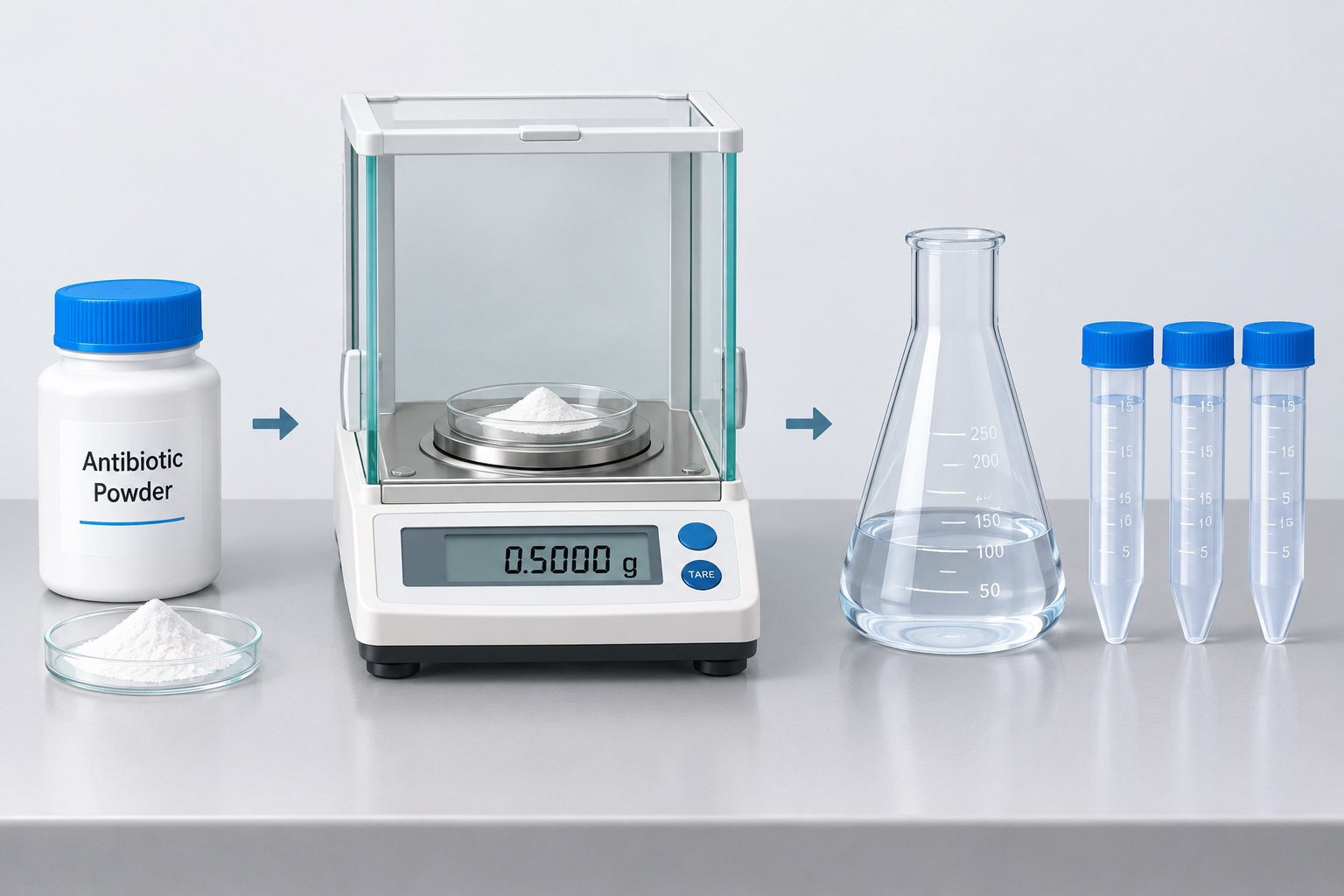
Antimicrobial agents are widely used in microbiological research to selectively inhibit the growth of unwanted microorganisms while permitting the growth or maintenance of the organism of interest. The preparation of concentrated antimicrobial stock solutions is therefore an important component of routine laboratory practice. Properly prepared and stored stocks allow antibiotics and antifungal agents to be added reproducibly to culture media at defined working concentrations, reducing variability between experiments and ensuring consistent selective conditions.
Chloramphenicol, cycloheximide, streptomycin and nystatin are all used to control microbial growth. They differ substantially in their chemical properties, antimicrobial spectra, solubility, stability, and recommended storage conditions. A single preparation or sterilization procedure cannot be applied universally. Each compound should be prepared using an appropriate solvent and concentration based on the manufacturer’s specifications, the laboratory’s validated standard operating procedure (SOP), and the intended experimental application.
Chloramphenicol is a broad-spectrum antibacterial agent commonly used for the selection and maintenance of bacterial cultures containing chloramphenicol-resistance markers. It is generally prepared as a concentrated stock in an appropriate organic solvent and stored in aliquots to minimize repeated freeze-thaw cycles. The stock is subsequently diluted into sterile culture media to achieve the required selective concentration.
Cycloheximide is an inhibitor of eukaryotic protein synthesis and is frequently used in microbiological media to suppress the growth of many fungi and other eukaryotic microorganisms. Because cycloheximide is primarily used as a selective agent rather than as an antibacterial antibiotic, its preparation and application should be clearly distinguished from those of bacterial selection antibiotics. Appropriate precautions are required during handling, and the working concentration should be selected according to the target organism and validated laboratory protocol.
Streptomycin is an aminoglycoside antibiotic that interferes with bacterial protein synthesis and is commonly used for selection of bacteria carrying streptomycin-resistance determinants. Streptomycin stocks are generally prepared in an aqueous solvent, although the exact formulation and storage conditions should follow the manufacturer’s recommendations. Maintaining appropriate stock concentration and storage conditions is important because loss of antimicrobial activity can compromise selection and experimental reproducibility.
Nystatin is an antifungal agent that acts primarily against susceptible fungi by interacting with membrane sterols. It is commonly incorporated into microbiological media when suppression of fungal contamination is required. Nystatin has different solubility characteristics from many conventional antibacterial antibiotics, and its preparation therefore requires particular attention to the recommended solvent, concentration, and handling conditions.
For all four compounds, accurate weighing, complete dissolution, appropriate labeling, aseptic handling, and validated storage are essential. Stock solutions should be prepared at clearly defined concentrations and divided into suitable aliquots where appropriate. Each aliquot should be labeled with the compound name, concentration, solvent, preparation date, and relevant identification information. Working solutions should be prepared using validated dilution calculations, and the final concentration should be confirmed before addition to culture media.
The procedures that follow provide standardized guidance for preparing these antimicrobial stocks while emphasizing accuracy, reproducibility, stability, safe handling, and appropriate application. Because antimicrobial activity and stability can vary with formulation and storage conditions, the manufacturer’s instructions and laboratory SOP should always take precedence where they differ from general guidance.
Preparation of chloramphenicol stock solution (25 mg/mL)
The aim is to prepare a 25 mg/mL chloramphenicol stock solution in 100% ethanol for selective bacterial culture. The stock solution can be aliquoted, stored frozen, and subsequently added to sterile culture media to achieve the required final working concentration.
Materials required for the experiment
- Chloramphenicol powder
- 100% ethanol
- Analytical balance
- Sterile spatula or weighing vessel
- Sterile tube suitable for at least 10 mL
- Vortex mixer
- Sterile 1.5 mL microcentrifuge tubes
- Pipettes and sterile pipette tips
- Biosafety cabinet or appropriate laboratory work area
- Appropriate personal protective equipment (PPE)
- Labels and permanent marker
Safety notice for chloramphenicol use
Chloramphenicol is a broad-spectrum antibiotic that inhibits bacterial protein synthesis by reversibly binding to the 50S ribosomal subunit. It should be handled in accordance with the manufacturer’s safety data sheet and the laboratory’s chemical-safety procedures. Wear appropriate PPE and avoid inhalation of chloramphenicol powder. Minimize the generation of dust and handle the powder using appropriate containment and ventilation.
Principle of chloramphenicol stock solution preparation
A 25 mg/mL chloramphenicol stock solution is prepared by dissolving 250 mg of chloramphenicol in a final volume of 10 mL of 100% ethanol.
Concentration = mass ÷ final volume
250 mg ÷ 10 mL = 25 mg/mL
The resulting stock is aliquoted into small volumes to minimize repeated freeze-thaw cycles and stored at -20°C, unless the manufacturer’s instructions or laboratory SOP specify otherwise.
Protocol for preparing chloramphenicol stock solution (25 mg/mL)
Preparation of the stock solution
- Clean and prepare the work area and gather all required materials.
- Accurately weigh 250 mg of chloramphenicol powder using an analytical balance.
- Transfer the powder into a suitable sterile tube.
- Add 10 mL of 100% ethanol to the tube.
- Cap the tube and mix using a vortex mixer until the chloramphenicol is completely dissolved and the solution appears clear.
- Confirm that the solution is homogeneous before aliquoting.
Sterilization of the solution
- Do not filter-sterilize the chloramphenicol stock. Ethanol used for the dissolution of the compound is enough substitute. Just ensure to work in aseptic conditions during its preparation.
- Maintain aseptic handling during transfer and aliquoting to minimize contamination.
Aliquoting and storage of the stock solution
- Using sterile pipette tips, dispense the stock solution into sterile 1.5 mL microcentrifuge tubes in appropriate aliquot volumes.
- Label each tube with: chloramphenicol, concentration (25 mg/mL), solvent (100% ethanol), date of preparation, and your name/initials.
- Store aliquots at -20°C, unless otherwise specified by the manufacturer’s instructions or laboratory SOP.
- Avoid repeated freeze-thaw cycles. Use a fresh aliquot where possible and discard aliquots showing contamination, precipitation, or other deterioration.
Application and working concentration
A 25 mg/mL chloramphenicol stock is equivalent to 25,000 µg/mL.
A 1:1,000 dilution gives:
25,000 µg/mL ÷ 1,000 = 25 µg/mL
Thus, adding 1 volume of stock to 999 volumes of culture medium produces a final concentration of 25 µg/mL.
If a different final concentration is required, calculate the volume of stock using C1V1 = C2V2 and follow the concentration specified by the bacterial strain, plasmid, selection system, and laboratory SOP.
Addition of stock solution to culture medium
Chloramphenicol stock should be added aseptically to sterile culture medium according to the laboratory’s validated procedure. For agar plates, allow autoclaved molten agar to cool to an appropriate handling temperature before adding the antibiotic stock. Mix thoroughly but gently before pouring plates.
Final points:
- The prepared stock is 25 mg/mL, not 25 µg/mL.
- A 1:1,000 dilution of this stock produces 25 µg/mL chloramphenicol.
- Published working concentrations can vary; use the concentration validated for the specific bacterial strain and selection system.
- Clearly label all aliquots and maintain appropriate preparation and storage records.
- Follow the laboratory SOP and manufacturer’s instructions for storage and use of chloramphenicol-containing media.
Preparation of cycloheximide stock solution (25 mg/mL)
The aim is to prepare a 25 mg/mL cycloheximide stock solution for use as an antifungal agent and protein-synthesis inhibitor. The stock solution can be aliquoted, stored frozen, and subsequently added to sterile culture media to achieve the required final working concentration.
Materials: The materials required are identical to those listed for the preparation of chloramphenicol, except that cycloheximide powder is used as the antibiotic source. Ethanol or DMSO may be used as the solvent, depending on the validated laboratory protocol.
Safety notice for cycloheximide use
Cycloheximide is highly toxic and should be handled according to the manufacturer’s safety data sheet (SDS) and the laboratory’s chemical-safety procedures. Avoid inhalation, ingestion, skin contact, and generation of airborne powder. Handle the powder inside a properly functioning chemical fume hood and use gloves and other PPE appropriate for the chemical and solvent being handled. Contaminated materials should be disposed of according to the laboratory’s hazardous-chemical waste procedures.
Principle of cycloheximide stock solution preparation
A 25 mg/mL cycloheximide stock solution is prepared by dissolving 250 mg of cycloheximide in a final volume of 10 mL of an appropriate solvent, such as 100% ethanol or DMSO.
Concentration = mass ÷ final volume
250 mg ÷ 10 mL = 25 mg/mL
The concentrated stock is then divided into small aliquots to minimize repeated freeze-thaw cycles and stored at -20°C, unless the manufacturer’s instructions or laboratory SOP specify otherwise.
Protocol for preparing cycloheximide stock solution (25 mg/mL)
Preparation of the stock solution
- Prepare the work area inside the appropriate chemical fume hood and gather all required materials.
- Accurately weigh 250 mg of cycloheximide powder using an analytical balance.
- Transfer the cycloheximide into a suitable tube.
- Add 10 mL of 100% ethanol or the validated solvent specified by the laboratory protocol.
- Cap the tube and mix using a vortex mixer until the cycloheximide is completely dissolved.
- If dissolution is incomplete, use a validated gentle warming or sonication procedure appropriate for the solvent and laboratory equipment. Avoid unnecessary heating and do not use temperatures outside the laboratory’s validated procedure.
- Confirm that the solution is homogeneous before aliquoting.
Sterilization of the solution
- Do not automatically filter-sterilize the stock. Follow the validated laboratory SOP and the manufacturer’s recommendations for preparation and handling.
- Maintain appropriate aseptic technique during transfer and aliquoting where the stock will subsequently be used for microbiological culture.
Aliquoting and storage of the stock solution
- Using appropriate pipette tips, dispense the stock solution into suitable sterile microcentrifuge tubes in convenient aliquot volumes.
- Wrap or protect the aliquots from light using aluminum foil, where required by the laboratory procedure.
- Label each tube with: cycloheximide, concentration (25 mg/mL), solvent, date of preparation, and your name.
- Store aliquots at -20°C, unless otherwise specified by the manufacturer’s instructions or laboratory SOP.
- Avoid repeated freeze-thaw cycles. Discard aliquots showing contamination, precipitation, or other deterioration.
Application and working concentration
A 25 mg/mL stock is equivalent to 25,000 µg/mL.
For example, a 1:1,000 dilution gives:
25,000 µg/mL ÷ 1,000 = 25 µg/mL
Therefore, 1 volume of stock added to 999 volumes of culture medium produces a final concentration of 25 µg/mL.
The appropriate cycloheximide concentration can vary substantially depending on the organism and experimental system. Reported concentrations may range from approximately 10-100 µg/mL or higher. The concentration should therefore be selected according to the organism, experimental objective, and validated laboratory protocol.
Addition of stock solution to culture medium
Add cycloheximide stock aseptically to sterile culture medium according to the laboratory’s validated procedure. For agar plates, allow autoclaved molten agar to cool to an appropriate handling temperature (usually 55-60oC) before adding the antibiotic/antifungal stock. Mix thoroughly but gently before pouring plates.
Final points:
- The prepared stock is 25 mg/mL, not 25 µg/mL.
- A 1:1,000 dilution gives 25 µg/mL final concentration.
- The required working concentration is organism- and assay-dependent.
- Clearly label all aliquots and maintain appropriate preparation and storage records.
- Follow the SDS, institutional chemical-safety requirements, and laboratory SOP for all handling and disposal of cycloheximide.
Preparation of streptomycin stock solution (100 mg/mL)
The aim is to prepare a sterile 100 mg/mL streptomycin sulfate stock solution for selective bacterial culture. The stock solution can be aliquoted, stored frozen, and subsequently added to sterile culture media to achieve the required final working concentration.
Materials: The materials required are identical to those listed for the preparation of chloramphenicol, except that streptomycin sulfate powder is used as the antibiotic source. Sterile distilled water (dH2O) used as the solvent, depending on the validated laboratory protocol.
Principle of streptomycin stock solution preparation
A 100 mg/mL streptomycin sulfate stock solution is prepared by dissolving 1.0 g of streptomycin sulfate in a final volume of 10 mL of sterile deionized water.
Concentration = mass ÷ final volume
1.0 g ÷ 10 mL = 0.1 g/mL = 100 mg/mL
The concentrated stock is then sterile-filtered and divided into small aliquots to minimize repeated freeze-thaw cycles.
Protocol for preparing streptomycin stock solution (100 mg/mL)
Preparation of the stock solution
- Clean and prepare the work area and gather all required materials.
- Accurately weigh 1.0 g of streptomycin sulfate powder using an analytical balance.
- Transfer the powder into a sterile 50 mL Falcon/conical tube.
- Add approximately 8-9 mL of sterile deionized water initially. Do not necessarily add the entire 10 mL at this stage, because the target is a final volume of 10 mL, rather than simply adding 10 mL of water.
- Cap the tube and mix gently using a vortex mixer until the streptomycin sulfate is completely dissolved.
- Once dissolved, bring the solution to a final volume of 10 mL with sterile deionized water.
- Mix thoroughly to ensure the solution is homogeneous.
Sterilization of the solution
- Using aseptic technique, transfer the solution into a sterile syringe.
- Pass the solution through a sterile 0.22 µm syringe filter into a clean, sterile, labelled tube.
- Avoid excessive pressure during filtration. If the filter becomes blocked, replace it rather than forcing the solution through.
Aliquoting and storage of the stock solution
- Using sterile pipette tips, dispense the filtered stock solution into sterile 1.5 mL microcentrifuge tubes in appropriate aliquot volumes.
- Label each tube with: streptomycin sulfate, concentration (100 mg/mL), date of preparation, and your name.
- Store aliquots at -20°C, unless the manufacturer’s instructions or laboratory SOP specify otherwise.
- Avoid repeated freeze-thaw cycles. Use a fresh aliquot when possible and discard aliquots showing evidence of contamination, precipitation, or other deterioration.
Application and working concentration
The 100 mg/mL stock is equivalent to 100,000 µg/mL.
For a final concentration of 50 µg/mL, the stock is diluted 1:2,000 (Table 1).
For a final concentration of 100 µg/mL, the stock is diluted 1:1,000.
Table 1. Volume of 100 mg/mL streptomycin sulfate stock solution required to prepare culture media at final concentrations of 50 µg/mL and 100 µg/mL
| Final medium volume | 50 µg/mL | 100 µg/mL |
| 10 mL | 5 µL | 10 µL |
| 50 mL | 25 µL | 50 µL |
| 100 mL | 50 µL | 100 µL |
| 500 mL | 250 µL | 500 µL |
| 1 L | 500 µL | 1 mL |
Addition of stock solution to culture medium
Streptomycin stock should be added aseptically to sterile culture medium according to the laboratory’s validated procedure. For agar plates, allow autoclaved molten agar to cool to an appropriate handling temperature before adding the antibiotic stock. Mix thoroughly but gently before pouring plates.
Final points:
- The prepared stock is 100 mg/mL, not 100 µg/mL.
- Common final working concentrations are 50-100 µg/mL, but the appropriate concentration depends on the bacterial strain, selection system, and laboratory SOP.
- Clearly label all aliquots and maintain appropriate preparation and storage records.
- Follow the manufacturer’s instructions and laboratory SOP for storage, handling, and use of streptomycin-containing media.
Preparation of nystatin stock solution (25 mg/mL)
The aim is to prepare a 25 mg/mL nystatin stock solution in anhydrous DMSO for antifungal applications. Nystatin is sensitive to heat, light, and aqueous conditions; therefore, the stock should be protected from light and handled according to the manufacturer’s instructions and laboratory SOP.
Materials: The materials required are identical to those listed for the preparation of cycloheximide, except that nystatin powder is used as the antibiotic source. 100% anhydrous DMSO may be used as the solvent, depending on the validated laboratory protocol.
Principle of nystatin stock solution preparation
A 25 mg/mL nystatin stock solution is prepared by dissolving 250 mg of nystatin in a final volume of 10 mL of 100% anhydrous DMSO.
Concentration = mass ÷ final volume
250 mg ÷ 10 mL = 25 mg/mL
Nystatin is highly sensitive to environmental conditions. The prepared stock should therefore be protected from light and unnecessary exposure to heat. Aliquoting minimizes repeated freeze-thaw cycles and reduces repeated exposure of the stock to light and air.
Protocol for preparing nystatin stock solution (25 mg/mL)
Preparation of the stock solution
- Clean and prepare the work area and gather all required materials.
- Accurately weigh 250 mg of nystatin powder using an analytical balance.
- Transfer the nystatin powder into a suitable sterile tube.
- Add 10 mL of 100% anhydrous DMSO.
- Cap the tube and vortex for approximately 30 seconds, or until the nystatin is adequately dispersed/dissolved according to the properties of the specific formulation.
- Avoid unnecessary exposure to light and heat during preparation.
Protection from light and sterilization
- Immediately wrap the tube in aluminum foil to protect the nystatin from light.
- Do not autoclave the nystatin stock.
- Do not assume that membrane filtration is appropriate for this preparation, as filtration may result in loss of material or reduced recovery. Follow the manufacturer’s validated handling instructions and laboratory SOP for any required sterilization.
Aliquoting and storage of the stock solution
- Using appropriate pipette tips, dispense the stock into small aliquots in suitable microcentrifuge tubes.
- Keep the aliquots protected from light by wrapping the tubes in aluminum foil or using light-protective containers.
- Label each tube with: nystatin, concentration (25 mg/mL), solvent (anhydrous DMSO), date of preparation, and your name/initials.
- Store aliquots at -20°C, unless the manufacturer’s instructions or laboratory SOP specify otherwise.
- Avoid repeated freeze-thaw cycles and minimize exposure to light during handling.
- For experiments requiring the highest precision and reproducibility, prepare fresh working solutions according to the validated laboratory procedure.
Application and working concentration
A 25 mg/mL nystatin stock is equivalent to 25,000 µg/mL.
For a final concentration of 50 µg/mL, a 25 mg/mL stock requires a 1:500 dilution.
For example:
25,000 µg/mL ÷ 500 = 50 µg/mL
The required volume of stock can be calculated using C1V1 = C2V2. The final concentration should be selected according to the fungal organism, experimental system, and validated laboratory protocol.
Alternative aqueous preparation
Nystatin may also be prepared as an aqueous suspension, rather than a clear solution, where this is appropriate for the experimental system. A 50 mg/mL suspension has been described as an alternative preparation. Because nystatin is poorly stable in aqueous conditions, this approach should only be used when specifically supported by the manufacturer’s instructions or laboratory SOP.
Addition of stock solution to culture medium
Add nystatin aseptically to the appropriate sterile culture medium according to the validated laboratory procedure. Avoid unnecessary exposure of nystatin-containing media to heat and light. For temperature-sensitive media, allow sterilized medium to cool appropriately before adding the nystatin preparation.
Final points:
- The primary stock described here is 25 mg/mL nystatin in anhydrous DMSO.
- A 1:500 dilution of this stock gives 50 µg/mL.
- Nystatin is sensitive to heat, light, and aqueous conditions; minimize exposure wherever possible.
- Do not autoclave the nystatin stock.
- Protect stock and aliquots from light and follow the manufacturer’s stability recommendations.
- The appropriate working concentration may vary by organism and experimental system; confirm the required concentration before use.
References
Heller, A. A., & Spence, D. M. (2019). A rapid method for post-antibiotic bacterial susceptibility testing. PLoS ONE, 14(1), e0210534.
Kerek, Á., Ecsedi, B. G., Szabó, Á., Szimrók, Z., Paliczné Kustán, B., Jerzsele, Á., & Nagy, G. (2024). Stability studies of the dilution series of different antibiotic stock solutions in culture medium incubated at 37°C. Antibiotics, 13(6), 549.
Maiti, P. K., Das, S., Sahoo, P., & Mandal, S. (2020). Streptomyces sp. SM01 isolated from Indian soil produces a novel antibiotic picolinamycin effective against multidrug-resistant bacterial strains. Scientific Reports, 10(1), 10092.
Shearer, G., Jr., & Sypherd, P. S. (1988). Cycloheximide efflux in antibiotic-adapted cells of the fungus Mucor racemosus. Antimicrobial Agents and Chemotherapy, 32(3), 341–345.
Barrick Lab. (n.d.). Media amendments: Antibiotic stock solutions. https://barricklab.org/twiki/bin/view/Lab/ProtocolsAntibioticStockSolutions
Chen, J., Tomasek, M., & Gau, V. (2021). Categorizing microbial growth inhibition through quantification of 16S rRNA growth marker with stripwells covering a spectrum of antimicrobial conditions. Methods, 8, 101453.
Clinical and Laboratory Standards Institute. (2009). Methods for dilution antimicrobial susceptibility tests for bacteria that grow aerobically: Approved standard—Eighth edition (CLSI document M07-A8). Clinical and Laboratory Standards Institute.
GOLDbio. (n.d.). How to make stock solutions for antibiotics and cell selection agents. https://www.goldbio.com/blogs/articles/how-to-make-stock-solutions-for-antibiotics-and-cell-selection-agents
Registry of Standard Biological Parts. (n.d.). Antibiotic stocks. iGEM. https://parts.igem.org/Help:Materials/Antibiotic_Stocks
Sigler. (n.d.). Working concentrations and stock solutions. University of Toledo. http://www.eeescience.utoledo.edu/Faculty/Sigler/Von_Sigler/LEPRProtocols_files/Working%20concentrations%20and%20stock%20solutions.pdf
Woźniak, A., Drożdż, K., Biegun-Drożdż, K., Gosiewski, T., Cudak, T., Karpiński, R., Fiołek, A., Błoniarz, A., Marchewka, J., Moskalewicz, T., & Brzychczy-Włoch, M. (2026). Biocidal activity of selected essential oils against bacterial and fungal pathogens and their cytotoxicity toward human cell lines. Microorganisms, 14(10), 2196.
NeoSynBio. (n.d.). Antibiotic stock solution mixing. https://www.neosynbio.com/antibiotic-stock-solution-mixing
Rrotocols.io. (n.d.). Antibiotic stocks. https://www.protocols.io/view/antibiotic-stocks-3byl47e1zlo5/v1
Discover more from Microbiology Class
Subscribe to get the latest posts sent to your email.