

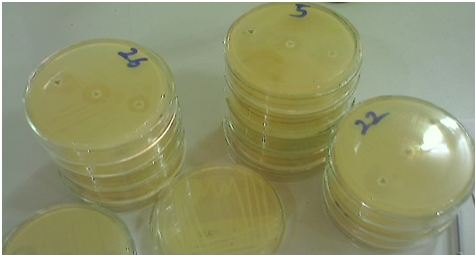
AmpC β-lactamases are bacterial enzymes that hydrolyze several β-lactam antibiotics, thereby reducing their effectiveness against Gram-negative bacterial pathogens. AmpC β-lactamase production refers to the ability of a bacterium to produce these enzymes, which can occur constitutively or through inducible expression in response to exposure to particular β-lactam agents. The ceftazidime–imipenem antagonism test (CIAT) is a phenotypic approach used to investigate inducible AmpC activity among bacterial isolates that demonstrate reduced susceptibility to screening antibiotics, particularly cefoxitin.
The principle of CIAT is based on the interaction between an inducing antibiotic and a β-lactam substrate. Imipenem can stimulate AmpC expression, while ceftazidime is susceptible to hydrolysis by AmpC enzymes. Consequently, increased AmpC activity near the imipenem disk may reduce the inhibitory effect of ceftazidime and produce a characteristic alteration in its inhibition zone. Comparison with cefoxitin provides additional phenotypic evidence. In this way, CIAT can help distinguish isolates exhibiting an inducible AmpC phenotype from those that do not show the expected antagonistic response.
Brief note on AmpC enzymes
Chromosomal AmpC enzymes (which can also be called inducible AmpC enzymes) and plasmid-borne AmpC enzymes are the two main types of AmpC beta-lactamases that exist amongst bacteria especially in Gram negative organisms – in which these multidrug resistant enzymes are produced. AmpC enzymes are broad-spectrum beta-lactamase enzymes that are usually encoded on bacterial chromosome, and which are active on cephamycins (e.g. cefoxitin and cefotetan) and oxyimino-β-lactam agents.
They can also be plasmid encoded; and AmpC enzymes like other extended or expanded beta-lactamases such as ESBLs and MBLs confer on pathogenic Gram negative bacteria the exceptional ability to be resistant to a wide array of beta-lactam drugs and non-beta-lactams. AmpC beta-lactamases are bacterial enzymes that hydrolyze third-generation extended spectrum cephalosporins and cephamycins (e.g. cefoxitin), thus engendering antimicrobial resistance to these categories of antibiotics.
AmpC beta-lactamases are differentiated from extended spectrum beta-lactamases (ESBLs) by the ability of the former (i.e. AmpC enzymes) to hydrolyze cephamycins (e.g. cefoxitin) and their lack of inhibition by clavulanic acid. The expression of AmpC enzyme is typically inducible in several Enterobacteriaceae and other Gram negative bacteria including but not limited to Escherichia coli, Klebsiella species, Enterobacter species and Pseudomonas aeruginosa; and the production of this enzyme facilitates the emergence under antibiotic pressure of highly resistant but stable depressed mutants of the organisms.
And these highly resistant but stably depressed mutants of the organisms have the ability to hydrolyze extended spectrum cephalosporins and other beta-lactam agents even though they may still remain susceptible to the carbapenems (e.g. imipenem and meropenem). The genes that codes for the production of AmpC enzymes in bacteria are normally chromosomally-mediated. Plasmid-mediated AmpC enzyme production in bacteria is also possible amongst bacterial organisms through genetic transfer mechanisms such as conjugation and transduction
Materials for CIAT
- Mueller-Hinton (MH) agar plates
- Sterile physiological saline
- Fresh bacterial isolates showing reduced susceptibility to cefoxitin
- 0.5 McFarland turbidity standard
- Sterile inoculating loop or sterile cotton swab
- Ceftazidime antibiotic disks (30 µg)
- Imipenem antibiotic disks (10 µg)
- Cefoxitin antibiotic disks (30 µg)
- Sterile forceps
- Incubator maintained at 37°C
- Ruler or measuring scale for determining disk spacing and inhibition zones
Preparation and performance of the CIAT
The CIAT should be performed on MH agar, using a bacterial suspension standardized to approximately 0.5 McFarland turbidity. The test organism should first be selected on the basis of an appropriate AmpC screening result. In particular, isolates exhibiting reduced susceptibility or resistance to cefoxitin may be considered suitable candidates for subsequent phenotypic confirmation. The use of a standardized inoculum is important because substantial variation in bacterial density can influence the size of antimicrobial inhibition zones and consequently affect interpretation of the test.
A fresh suspension of the test isolate is adjusted to the 0.5 McFarland standard and used to inoculate the surface of the MH agar plate uniformly. The objective is to produce an even bacterial lawn across the agar surface. Uneven inoculation may generate irregular inhibition zones and make subtle antagonistic effects difficult to recognize. After inoculation, antimicrobial disks are positioned on the agar according to the test arrangement.
For CIAT, a ceftazidime disk containing 30 µg and an imipenem disk containing 10 µg are placed approximately 20 mm apart. The distance between the disks is important because the test depends on the local interaction between the antibiotics and the bacterial response. A cefoxitin disk containing 30 µg is also positioned approximately 20 mm from the ceftazidime disk. This arrangement permits the inhibition zone surrounding ceftazidime to be examined in relation to both an established AmpC-inducing agent and imipenem.
Following disk placement, the inoculated MH agar plate is incubated at approximately 37°C for 18-24 hours under the laboratory conditions routinely used for bacterial antimicrobial susceptibility testing. Following incubation, the inhibition zones surrounding the disks are examined carefully. Particular attention should be given to the portion of the ceftazidime inhibition zone facing the imipenem disk and, for comparison, the portion facing the cefoxitin disk.
The test should be conducted under standardized laboratory conditions because disk potency, agar composition, inoculum concentration, incubation conditions, and disk spacing can all influence the observed inhibition pattern. Appropriate quality-control procedures should therefore accompany the test where applicable. CIAT results should also be interpreted together with the organism’s initial screening phenotype rather than being considered independently.
Summary of CIAT methods
- Fresh cultures of the selected bacterial isolates showing reduced susceptibility to cefoxitin during the AmpC screening test should be prepared.
- A bacterial suspension should be prepared in sterile physiological saline and adjusted to a turbidity equivalent to the 0.5 McFarland standard.
- The standardized bacterial suspension should be evenly inoculated onto the surface of a MH agar plate to obtain a uniform bacterial lawn.
- Using sterile forceps, a ceftazidime (30 µg) disk and an imipenem (10 µg) disk should be placed approximately 20 mm apart on the inoculated MH agar surface.
- A cefoxitin (30 µg) disk should also be placed approximately 20 mm from the ceftazidime disk to provide a comparative assessment of antibiotic antagonism.
- The inoculated MH agar plates should be incubated at 37°C for 18-24 hours.
- Following incubation, the inhibition zone surrounding the ceftazidime disk should be examined, particularly on the sides facing the imipenem and cefoxitin disks.
- A visible reduction or distortion of the ceftazidime inhibition zone toward the imipenem or cefoxitin disk should be recorded as an antagonistic effect.
- A distinct antagonistic pattern should be interpreted as phenotypic evidence suggestive of inducible AmpC β-lactamase production.
- The CIAT findings should be interpreted together with the results of the initial AmpC screening test to support the phenotypic characterization of the test bacterial isolates.
Interpretation of antagonism and phenotypic inference of AmpC production
The central observation in CIAT is a localized reduction or distortion of the inhibition zone around the ceftazidime disk in the direction of the imipenem or cefoxitin disk. This phenomenon is referred to as antagonism. A positive antagonistic response suggests that exposure to the inducing antibiotic has altered β-lactamase expression sufficiently to decrease the apparent activity of ceftazidime against the test isolate.
The biological basis of this observation is associated with inducible AmpC expression. When an appropriate inducing β-lactam is present, the bacterium may increase production of AmpC β-lactamase. The resulting increase in enzymatic activity can enhance degradation of susceptible β-lactam compounds in the surrounding area. If ceftazidime is positioned close enough to the inducing antibiotic, the enhanced AmpC activity may become visible as a reduction in the ceftazidime inhibition zone adjacent to the inducer. Thus, the test provides a visual representation of an antibiotic–enzyme interaction occurring within the bacterial population growing on the agar surface.
A positive CIAT phenotype is therefore inferred when a clearly observable reduction in the ceftazidime inhibition zone occurs on the side nearest the imipenem disk and/or cefoxitin disk, particularly when the pattern is consistent with the expected antagonistic response (Figure 1 and Figure 2). The cefoxitin comparison is useful because cefoxitin is recognized as an important inducer of AmpC expression and can provide a reference pattern for assessing the response observed around imipenem.


A negative result would be characterized by the absence of a convincing antagonistic effect, with the ceftazidime inhibition zone remaining relatively uniform between the opposing sides of the disk. However, interpretation should not depend on a minor irregularity or an isolated change in zone shape. The observed pattern should be sufficiently distinct to support a biological interpretation rather than representing random variation in the agar lawn or disk placement.
CIAT is particularly useful as a phenotypic confirmation approach following screening, rather than as a stand-alone method for definitively characterizing the genetic basis of AmpC production. A phenotypically positive isolate may possess an inducible AmpC phenotype, but phenotypic testing alone cannot establish the precise AmpC gene, its genetic origin, or the complete molecular mechanism responsible for resistance. Molecular assays can provide further characterization where such information is required.
The significance of detecting inducible AmpC production extends beyond the laboratory classification of an isolate. AmpC-mediated resistance can complicate antimicrobial susceptibility interpretation because bacterial expression of the enzyme may change during exposure to β-lactam antibiotics. An isolate that initially appears susceptible to a particular agent may therefore present a more complex resistance phenotype under selective antibiotic pressure. Identifying an inducible AmpC phenotype can consequently provide valuable information for antimicrobial resistance surveillance and for understanding the resistance characteristics of clinically or epidemiologically important bacterial isolates.
CIAT provides a practical phenotypic framework for investigating inducible AmpC activity through the observable interaction between ceftazidime and potential inducing agents. The test begins with an isolate selected through AmpC screening, proceeds through standardized inoculation and disk placement on MH agar, and culminates in visual assessment of the ceftazidime inhibition zone. A reproducible antagonistic pattern adjacent to imipenem or cefoxitin supports phenotypic inference of inducible AmpC β-lactamase production. When incorporated into a broader antimicrobial susceptibility-testing strategy and interpreted alongside appropriate controls and complementary methods, CIAT can contribute useful evidence for identifying isolates with clinically relevant AmpC-associated resistance characteristics.
Further reading
Ejikeugwu Chika, Esimone Charles, Iroha Ifeanyichukwu, Adikwu Michael (2018). First Detection of FOX-1 AmpC β-lactamase gene expression among Escherichia coli isolated from abattoir samples in Abakaliki, Nigeria. Oman Medical Journal, 33(3):243-249.
Ejikeugwu C, Duru Carissa, Edeh Chijioke, Iroha Ifeanyichukwu (2017). Prevalence of AmpC β-lactamase-producing Pseudomonas aeruginosa Isolates from feacal matter of cow. Journal of Microbiology and Experimentation, 4(5):1-4.
Ejikeugwu C, Duru Carissa, Iroha Ifeanyichukwu, Oguejiofor Benigna, Okoro Loveday, Ugwu Malachy (2017). Detection of Escherichia coli strains producing AmpC enzymes using Ceftazidime-Imipenem Antagonism Test (CIAT). International Journal of Research Studies in Biosciences, 5(1):41-45.
Ejikeugwu C, Iroha Ifeanyichukwu, Ugwu Malachy, Oguejiofor Benigna, Eze Chinemelum Adaora, Araka Olisa, Orji Okoro, Esimone Charles, Adikwu Michael (2016). Phenotypic detection of AmpC enzymes and antimicrobial susceptibility of Klebsiella species isolated from abattoir. International Journal of Applied Microbiology and Biotechnology Research, 4:117-121.
Ejikeugwu C, Esimone Charles, Iroha Ifeanyichukwu, Ugwu Chigozie, Ezeador Chika, Duru Carissa, Adikwu Michael (2016). Phenotypic detection of AmpC beta-lactamase among anal Pseudomonas aeruginosa isolates in a Nigerian abattoir. Archives of Clinical Microbiology, 7(2):1-5.
Discover more from Microbiology Class
Subscribe to get the latest posts sent to your email.