

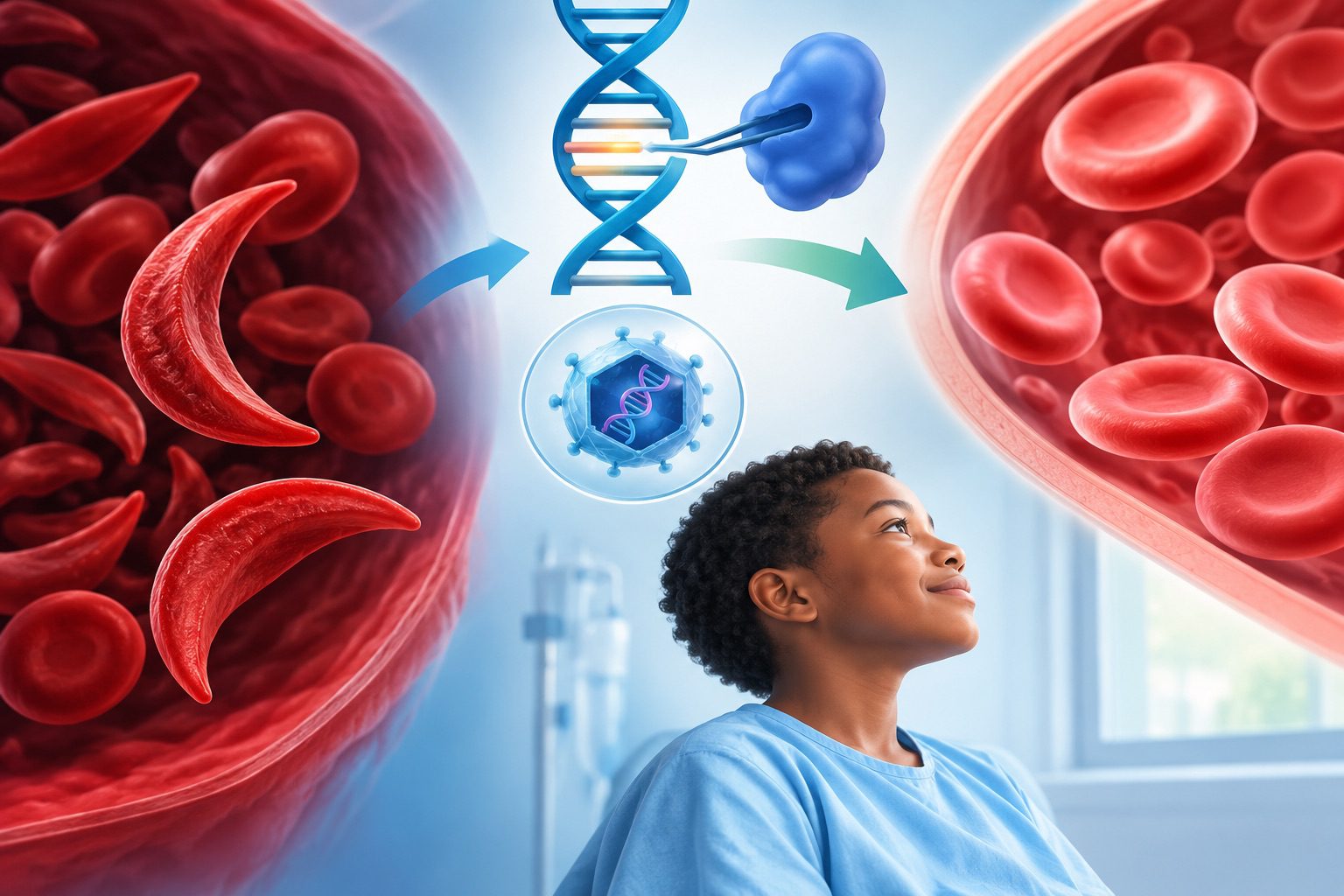
What is Sickle Cell Disease?
Sickle Cell Disease (SCD) is a group of inherited blood disorders characterized by the production of abnormal hemoglobin. Hemoglobin is the protein responsible for carrying oxygen throughout the body. The condition primarily affects red blood cells, which normally have a flexible, disc-like shape that allows them to move easily through blood vessels. In people with SCD, abnormal hemoglobin causes red blood cells to become rigid and develop a characteristic crescent or “sickle” shape, particularly under conditions of low oxygen, dehydration, infection, or physiological stress. These altered cells can obstruct blood flow, break down prematurely, and contribute to a wide range of acute and chronic complications.
SCD is caused by genetic variants affecting the beta-globin gene, which is involved in hemoglobin production. The most common and clinically significant form is sickle cell anemia, generally associated with the HbSS genotype. Other forms include HbSC disease and sickle beta-thalassemia, each of which can produce varying degrees of disease severity. Because SCD is inherited, individuals develop the condition when they receive relevant disease-associated hemoglobin variants from their parents.
A central feature of SCD is chronic hemolytic anemia. Sickle-shaped red blood cells have a shortened lifespan and are continuously destroyed, reducing the blood’s capacity to transport oxygen. At the same time, the abnormal cells can adhere to blood vessel walls and obstruct small blood vessels, producing episodes known as vaso-occlusive crises. These episodes can cause severe and unpredictable pain and may result in tissue and organ damage over time.
The clinical manifestations of SCD are diverse and can begin during childhood. Common complications include recurrent pain episodes, fatigue, anemia, jaundice, infections, acute chest syndrome, stroke, kidney dysfunction, pulmonary complications, leg ulcers, and damage to the spleen and other organs. The disease can also affect growth, physical development, education, employment, and overall quality of life. Disease severity varies considerably among individuals and may be influenced by genetic, environmental, and clinical factors.
SCD represents a significant lifelong health burden requiring continuous medical management and monitoring. Diagnosis commonly involves blood testing and specialized hemoglobin analysis, while newborn screening enables early identification and intervention. Management may include preventive care, vaccination, infection prevention, pain management, blood transfusions, and medications designed to reduce complications. Understanding the genetic basis, pathophysiology, clinical manifestations, complications, and long-term impact of SCD is essential for improving diagnosis, treatment, and patient outcomes.
Gene therapy as a treatment for sickle cell disease
Gene therapy has emerged as a promising treatment approach for SCD. SCD is a genetic disorder caused by mutations in the beta-globin gene that result in the production of abnormal hemoglobin. This abnormal hemoglobin causes red blood cells to become rigid and sickle-shaped, leading to anemia, severe pain, organ damage, and other complications. Unlike conventional treatments that mainly manage symptoms, gene therapy aims to address the underlying genetic cause of the disease.
One approach involves modifying a patient’s own blood-forming stem cells. These cells are collected from the patient and genetically modified in a laboratory before being returned to the body. Some therapies introduce a functional or modified beta-globin gene so that the cells can produce healthier hemoglobin. Another approach uses gene editing techniques, such as CRISPR, to modify regulatory regions of the genome and reactivate production of fetal hemoglobin (HbF). Increased HbF can prevent red blood cells from sickling and reduce disease complications.
After genetic modification, patients receive conditioning treatment to make space in the bone marrow for the edited stem cells. The modified cells are then infused back into the patient, where they can establish themselves and produce new blood cells. Successful treatment may reduce or eliminate severe vaso-occlusive pain episodes and decrease the need for blood transfusions.
Gene therapy offers the possibility of a long-lasting treatment because modified stem cells can continuously produce genetically corrected blood cells. However, it also has important limitations and risks. Conditioning chemotherapy can cause significant side effects, while gene-editing procedures may carry risks such as unintended genetic changes, infertility, infection, or other long-term complications. Treatment is also technically complex and expensive, which can limit accessibility.
Gene therapy represents a major advancement in SCD treatment. By targeting the disease at its genetic and cellular roots, it has the potential to transform SCD from a lifelong condition requiring continuous management into a disease that can be treated with a potentially durable, one-time intervention.
Casgevy and Lyfgenia: U.S. FDA-approved gene therapies for SCD
The U.S. Food and Drug Administration approved two milestone gene therapy treatments for sickle cell. These gene therapy treatments are Casgevy and Lyfgenia. Casgevy and Lyfgenia represent the first cell-based gene therapies for the treatment of sickle cell disease (SCD) in patients 12 years and older. One of these therapies, Casgevy, is the first FDA-approved treatment to utilize a type of novel genome editing technology, signaling an innovative advancement in the field of gene therapy.
Sickle cell disease is a group of inherited blood disorders affecting approximately 100,000 people in the U.S. It is most common in African Americans and, while less prevalent, also affects Hispanic Americans. The primary problem in sickle cell disease is a mutation in hemoglobin, a protein found in red blood cells that delivers oxygen to the body’s tissues. This mutation causes red blood cells to develop a crescent or “sickle” shape. These sickled red blood cells restrict the flow in blood vessels and limit oxygen delivery to the body’s tissues, leading to severe pain and organ damage called vaso-occlusive events (VOEs) or vaso-occlusive crises (VOCs). The recurrence of these events or crises can lead to life-threatening disabilities and/or early death.
“Sickle cell disease is a rare, debilitating and life-threatening blood disorder with significant unmet need, and we are excited to advance the field especially for individuals whose lives have been severely disrupted by the disease by approving two cell-based gene therapies today,” said Nicole Verdun, M.D., director of the Office of Therapeutic Products within the FDA’s Center for Biologics Evaluation and Research. “Gene therapy holds the promise of delivering more targeted and effective treatments, especially for individuals with rare diseases where the current treatment options are limited.”
Casgevy, a cell-based gene therapy, is approved for the treatment of sickle cell disease in patients 12 years of age and older with recurrent vaso-occlusive crises. Casgevy is the first FDA-approved therapy utilizing CRISPR/Cas9, a type of genome editing technology. Patients’ hematopoietic (blood) stem cells are modified by genome editing using CRISPR/Cas9 technology.
CRISPR/Cas9 can be directed to cut DNA in targeted areas, enabling the ability to accurately edit (remove, add, or replace) DNA where it was cut. The modified blood stem cells are transplanted back into the patient where they engraft (attach and multiply) within the bone marrow and increase the production of fetal hemoglobin (HbF), a type of hemoglobin that facilitates oxygen delivery. In patients with sickle cell disease, increased levels of HbF prevent the sickling of red blood cells.
Lyfgenia is a cell-based gene therapy. Lyfgenia uses a lentiviral vector (gene delivery vehicle) for genetic modification and is approved for the treatment of patients 12 years of age and older with sickle cell disease and a history of vaso-occlusive events. With Lyfgenia, the patient’s blood stem cells are genetically modified to produce HbAT87Q, a gene-therapy derived hemoglobin that functions similarly to hemoglobin A, which is the normal adult hemoglobin produced in persons not affected by sickle cell disease. Red blood cells containing HbAT87Q have a lower risk of sickling and occluding blood flow. These modified stem cells are then delivered to the patient.
Both products are made from the patients’ own blood stem cells, which are modified, and are given back as a one-time, single-dose infusion as part of a hematopoietic (blood) stem cell transplant. Prior to treatment, a patients’ own stem cells are collected, and then the patient must undergo myeloablative conditioning (high-dose chemotherapy), a process that removes cells from the bone marrow so they can be replaced with the modified cells in Casgevy and Lyfgenia. Patients who received Casgevy or Lyfgenia will be followed in a long-term study to evaluate each product’s safety and effectiveness.
“These approvals represent an important medical advance with the use of innovative cell-based gene therapies to target potentially devastating diseases and improve public health,” said Peter Marks, M.D., Ph.D., director of the FDA’s Center for Biologics Evaluation and Research. “Today’s actions follow rigorous evaluations of the scientific and clinical data needed to support approval, reflecting the FDA’s commitment to facilitating development of safe and effective treatments for conditions with severe impacts on human health.”
Data supporting Casgevy
The safety and effectiveness of Casgevy were evaluated in an ongoing single-arm, multi-center trial in adult and adolescent patients with SCD. Patients had a history of at least two protocol-defined severe VOCs during each of the two years prior to screening. The primary efficacy outcome was freedom from severe VOC episodes for at least 12 consecutive months during the 24-month follow-up period. A total of 44 patients were treated with Casgevy. Of the 31 patients with sufficient follow-up time to be evaluable, 29 (93.5%) achieved this outcome. All treated patients achieved successful engraftment with no patients experiencing graft failure or graft rejection.
The most common side effects were low levels of platelets and white blood cells, mouth sores, nausea, musculoskeletal pain, abdominal pain, vomiting, febrile neutropenia (fever and low white blood cell count), headache and itching.
Data supporting Lyfgenia
The safety and effectiveness of Lyfgenia is based on the analysis of data from a single-arm, 24-month multicenter study in patients with sickle cell disease and history of VOEs between the ages of 12- and 50- years old. Effectiveness was evaluated based on complete resolution of VOEs (VOE-CR) between 6 and 18 months after infusion with Lyfgenia. Twenty-eight (88%) of 32 patients achieved VOE-CR during this time period.
The most common side effects included stomatitis (mouth sores of the lips, mouth, and throat), low levels of platelets, white blood cells, and red blood cells, and febrile neutropenia (fever and low white blood cell count), consistent with chemotherapy and underlying disease.
Hematologic malignancy (blood cancer) has occurred in patients treated with Lyfgenia. A black box warning is included in the label for Lyfgenia with information regarding this risk. Patients receiving this product should have lifelong monitoring for these malignancies.
Both the Casgevy and Lyfgenia applications received Priority Review, Orphan Drug, Fast Track and Regenerative Medicine Advanced Therapy designations.
The FDA granted approval of Casgevy to Vertex Pharmaceuticals Inc. and approval of Lyfgenia to Bluebird Bio Inc.
Source
www.fda.gov/news-events/press-announcements/fda-approves-first-gene-therapies-treat-patients-sickle-cell-disease
Discover more from Microbiology Class
Subscribe to get the latest posts sent to your email.