
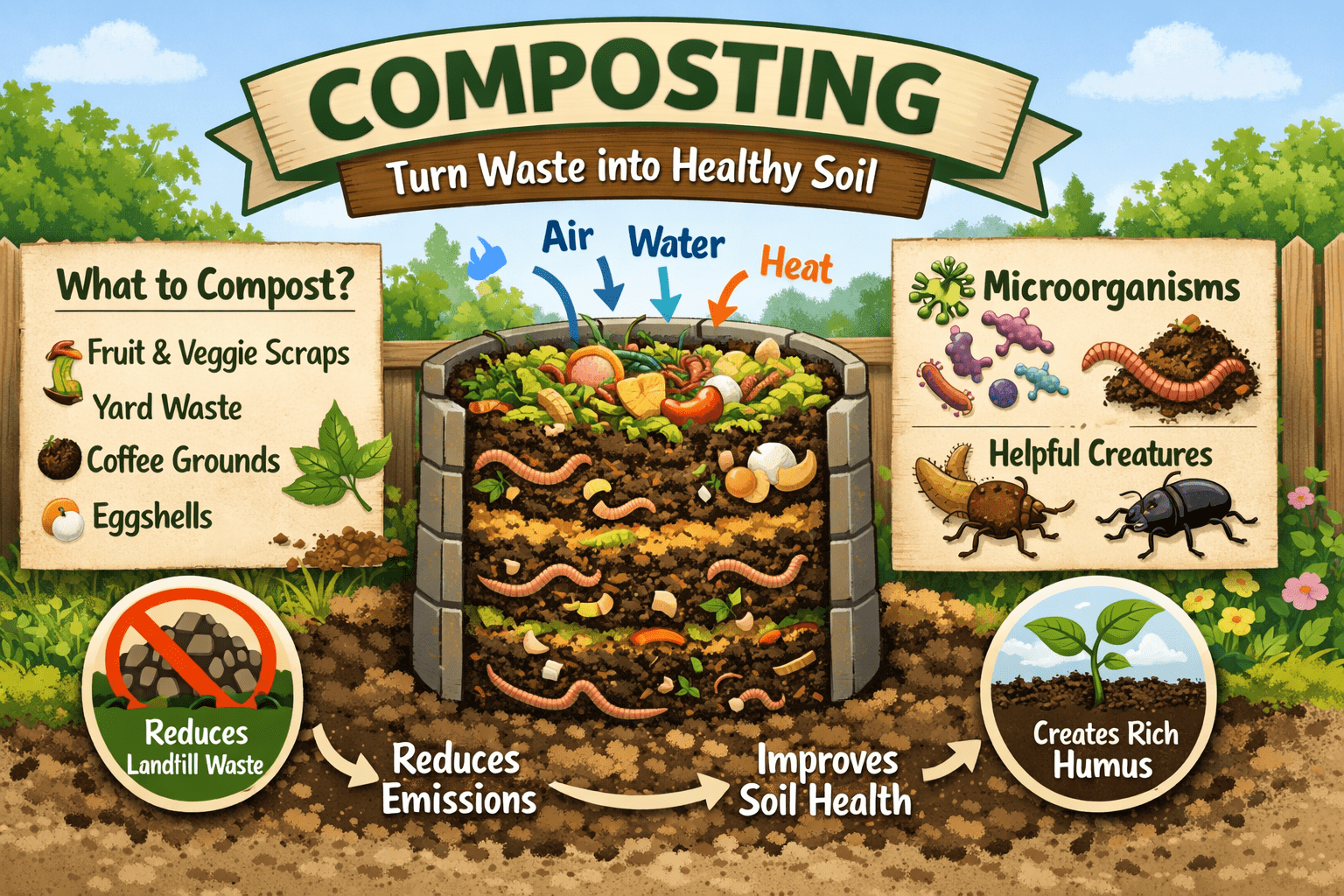
Composting is one of the most practical, sustainable, and environmentally sound approaches for managing organic waste while simultaneously improving soil fertility and agricultural productivity. In its simplest form, compost is organic matter derived from plant, animal, or biodegradable human waste that has undergone controlled decomposition and stabilization. The resulting material is reused as a soil amendment or organic fertilizer capable of improving soil structure, nutrient availability, and biological activity. Unlike synthetic fertilizers, compost enhances soil health holistically by supporting physical, chemical, and biological soil processes.
The growing global concerns surrounding soil degradation, declining agricultural productivity, climate change, and the accumulation of organic waste in landfills have renewed interest in composting as both an agricultural practice and a waste management strategy. Composting represents a closed-loop system in which organic residues are recycled back into productive use rather than discarded as waste. This process not only conserves natural resources but also reduces environmental pollution and greenhouse gas emissions.
Definition and Concept of Composting
Compost can be defined as a stabilized organic product resulting from the aerobic decomposition of organic materials of plant and animal origin. Composting is the controlled biological process through which microorganisms convert biodegradable organic matter into a humus-like substance under aerobic conditions. The process relies on adequate oxygen, moisture, and nutrient balance to facilitate microbial metabolism and growth.
A person who engages in the practice of composting is referred to as a composter. Composting is not merely the decay of organic matter; rather, it is a managed process that accelerates natural decomposition while minimizing environmental nuisances such as odors, pests, and greenhouse gas emissions. Through composting, organic residues that would otherwise contribute to environmental pollution are transformed into a valuable resource that improves soil quality and plant growth.
Composting has been practiced for centuries in traditional agricultural systems, long before the advent of chemical fertilizers. Farmers historically relied on decomposed plant residues, animal manures, and household wastes to replenish soil nutrients and maintain productivity. Today, composting has evolved into a scientifically guided practice that can be implemented at household, community, municipal, and industrial scales.
The Biological Basis of Composting
The composting process is fundamentally biological and is driven by a diverse community of microorganisms. These microorganisms metabolize organic substrates, using them as sources of carbon, energy, and nutrients. The primary microbial groups involved in composting include bacteria, fungi (moulds and yeasts), actinomycetes, and protozoa. Each group plays a specific role at different stages of decomposition.
Bacteria are the most abundant and active decomposers in composting systems. They initiate the breakdown of readily degradable compounds such as sugars, amino acids, and proteins. As bacterial metabolism increases, heat is generated, causing the compost pile temperature to rise. This thermophilic phase is critical for rapid decomposition and pathogen reduction.
Fungi, including moulds and yeasts, are particularly important for decomposing complex organic compounds such as cellulose, hemicellulose, and lignin. Their filamentous growth allows them to penetrate tough plant materials, thereby increasing the surface area available for further microbial action. Actinomycetes, which resemble fungi but are classified as bacteria, are responsible for breaking down resistant compounds and are largely responsible for the earthy smell associated with mature compost.
In addition to microorganisms, larger organisms such as earthworms, beetles, centipedes, mites, snails, and slugs contribute to composting. These organisms fragment organic matter, enhance aeration, and stimulate microbial activity through their feeding and burrowing actions. Collectively, these biological agents convert raw organic waste into stable humus.
Humus and the Process of Humification
Humus is a dark brown or black, complex organic substance formed through the decomposition and transformation of plant and animal residues in a process known as humification. Humification can occur naturally in soils or artificially through composting. Humus represents the final and most stable fraction of organic matter and is highly resistant to further decomposition.
The presence of humus in soil is a key indicator of soil fertility and health. Physically, humus improves soil structure by promoting the formation of stable soil aggregates. This enhances soil porosity, aeration, and water infiltration, while reducing erosion and compaction. Chemically, humus has a high cation exchange capacity, allowing it to retain and gradually release essential plant nutrients such as nitrogen, phosphorus, potassium, calcium, and magnesium.
Nitrogen is one of the most important nutrients contained in humus, as it is essential for plant growth and chlorophyll formation. Humus also buffers soil pH, making soils less susceptible to rapid changes in acidity or alkalinity. Biologically, humus provides energy and habitat for beneficial soil microorganisms, thereby sustaining soil biological activity and nutrient cycling.
Composting Conditions and Process Dynamics
Successful composting depends on maintaining optimal environmental conditions that favor aerobic microbial activity. The key factors influencing composting include oxygen availability, moisture content, temperature, nutrient balance, and particle size of the feedstock.
Oxygen is essential for aerobic microorganisms that drive the composting process. Adequate aeration prevents anaerobic conditions, which can lead to foul odors and the production of methane. Aeration can be achieved through turning the compost pile, using perforated pipes, or maintaining appropriate pile structure.
Moisture is equally critical, as microorganisms require water for metabolic activity. Compost materials should be moist but not waterlogged, typically containing 40–60% moisture. Excessive moisture restricts oxygen diffusion, while insufficient moisture slows microbial activity.
Temperature is an important indicator of composting activity. During active decomposition, compost temperatures can rise to 50–70°C due to microbial heat generation. These high temperatures accelerate decomposition and destroy weed seeds and pathogenic organisms. As the compost matures, temperatures gradually decline to ambient levels.
The carbon-to-nitrogen (C:N) ratio of compost feedstock strongly influences decomposition rates. Carbon serves as an energy source, while nitrogen is essential for microbial protein synthesis. An initial C:N ratio of approximately 25–30:1 is generally considered optimal for composting.
Compost Feedstock and Raw Materials
Compost can be produced from a wide range of organic materials, commonly referred to as feedstock. These materials may originate from agricultural, household, industrial, or municipal sources. Plant-based materials include leaves, grass clippings, crop residues, straw, corn cobs, sawdust, and paper products. Animal-based materials include manure, bedding materials, and food scraps of animal origin.
Municipal organic waste, such as kitchen scraps, yard waste, and dewatered sewage sludge, also serves as a valuable compost feedstock when properly managed. Recycling these materials through composting reduces the burden on landfills and transforms waste into a beneficial soil amendment.
The diversity of feedstock materials contributes to a balanced nutrient composition in compost. However, care must be taken to avoid materials contaminated with heavy metals, pesticides, or persistent organic pollutants, as these can compromise compost quality and environmental safety.
Environmental Significance of Composting
Composting plays a critical role in environmental protection and sustainability. One of its most important benefits is the reduction of organic waste sent to landfills. When organic waste decomposes anaerobically in landfills, it produces methane, a greenhouse gas with a global warming potential significantly higher than that of carbon dioxide. Composting diverts organic waste from landfills and promotes aerobic decomposition, thereby reducing methane emissions and mitigating climate change.
Composting also contributes to resource conservation by recycling organic matter and nutrients back into the soil. This reduces the reliance on synthetic fertilizers, whose production is energy-intensive and often associated with environmental pollution. By improving soil structure and water-holding capacity, composting reduces irrigation demands and minimizes nutrient leaching into groundwater and surface water bodies.
Furthermore, composting helps prevent water pollution by reducing runoff of excess nutrients into rivers and lakes. Excess nutrients can cause eutrophication and harmful algal blooms, which deplete oxygen levels and threaten aquatic life. By releasing nutrients slowly and improving soil retention, compost minimizes these risks.
Agricultural and Soil Health Benefits of Composting
Composting significantly enhances soil fertility and productivity. Compost supplies a wide range of macro- and micronutrients required for plant growth, including nitrogen, phosphorus, potassium, calcium, magnesium, iron, zinc, and manganese. Unlike chemical fertilizers, compost releases nutrients gradually, ensuring sustained nutrient availability and reducing the risk of nutrient burn.
Compost improves soil water-holding capacity, particularly in sandy soils, thereby reducing drought stress on crops. In clay soils, compost enhances aggregation and drainage, reducing waterlogging and root suffocation. These improvements in soil physical properties promote healthy root development and increase crop resilience.
Biologically, compost supports a diverse and active soil microbiome. Beneficial microorganisms contribute to nutrient cycling, disease suppression, and plant growth promotion. The presence of organic matter encourages earthworm activity, which further improves soil aeration, structure, and nutrient distribution through burrowing and casting.
Composting as a Sustainable Waste Management Strategy
Beyond agriculture, composting is an effective and sustainable alternative to landfilling and incineration for managing organic waste. Landfilling consumes valuable land resources and generates leachate and greenhouse gases, while incineration can produce toxic emissions and ash residues. Composting, by contrast, transforms waste into a beneficial product with minimal environmental impact.
At the community and municipal levels, composting programs can significantly reduce waste management costs while promoting environmental awareness and participation. Household composting empowers individuals to manage their organic waste responsibly and contribute directly to environmental sustainability.
Composting is a time-tested, scientifically supported practice that transforms organic waste into a valuable resource for soil fertility and environmental sustainability. Through the controlled aerobic decomposition of organic matter, composting produces humus-rich compost that enhances soil structure, nutrient availability, water retention, and biological activity.
The benefits of composting extend beyond agriculture to include waste reduction, climate change mitigation, water quality protection, and resource conservation. By reducing dependence on chemical fertilizers and diverting organic waste from landfills, composting supports sustainable land management and ecological resilience.
In an era of increasing environmental challenges, composting stands out as a simple, cost-effective, and scalable solution that aligns agricultural productivity with environmental stewardship. Harnessing composting as a core practice is therefore essential for building sustainable food systems, healthy soils, and a greener future.
References
Abrahams P.W (2006). Soil, geography and human disease: a critical review of the importance of medical cartography. Progress in Physical Geography, 30:490-512.
Andersson L and Rydberg L (1988). Trends in nutrient and oxygen conditions within the Kattegat: effects on local nutrient supply. Estuar. Coast. Shelf Sci, 26:559–579.
Bunting B.T. and Lundberg J (1995). The humus profile-concept, class and reality. Geoderma, 40:17–36.
Jee C and Shagufta (2007). Environmental Biotechnology. APH Publishing Corporation, Darya Ganj, New Delhi, India.
Maier R.M, Pepper I.L. and Gerba C.P (2000). Environmental Microbiology. Academic Press, San Diego.
Mishra B.B, Nanda D.R and Dave S.R (2009). Environmental Microbiology. First edition. APH Publishing Corporation, Ansari Road, Darya Ganj, New Delhi, India.
Paul E.A (2007). Soil Microbiology, ecology and biochemistry. 3rd edition. Oxford: Elsevier Publications, New York.
Pelczar M.J Jr, Chan E.C.S, Krieg N.R (1993). Microbiology: Concepts and Applications. McGraw-Hill, USA.
Pelczar M.J., Chan E.C.S. and Krieg N.R. (2003). Microbiology of Soil. Microbiology, 5th Edition. Tata McGraw-Hill Publishing Company Limited, New Delhi, India.
Pepper I.L and Gerba C.P (2005). Environmental Microbiology: A Laboratory Manual. Second Edition. Elsevier Academic Press, New York, USA.
Discover more from Microbiology Class
Subscribe to get the latest posts sent to your email.