

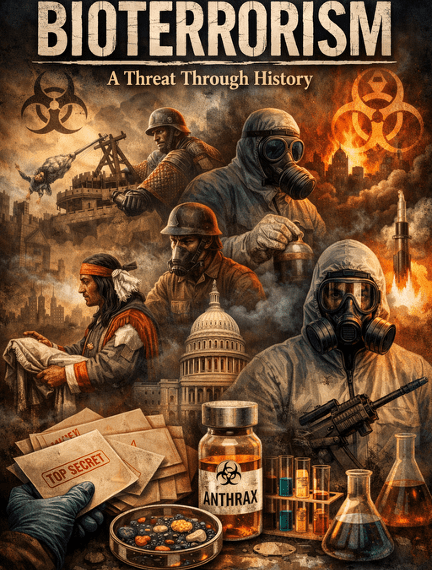
Bioterrorism refers to the deliberate use of biological agents such as bacteria, viruses, fungi, or toxins to cause disease or death in humans, animals, or plants for the purpose of intimidation, coercion, or warfare. Although modern discussions about bioterrorism often emphasize advanced biotechnology and genetic engineering, the concept itself is far from new. The intentional use of biological materials as weapons predates modern microbiology and the scientific understanding of infectious diseases.
Historically, warfare strategies have included the exploitation of disease as a tactical tool. Long before the establishment of the germ theory of disease by scientists such as Robert Koch and Louis Pasteur in the nineteenth century, military leaders and societies recognized that contaminated materials, diseased corpses, and infected individuals could be used to weaken enemies. These early forms of biological warfare were primitive yet often devastating.
Over time, technological progress transformed biological warfare from crude contamination tactics into organized state-run weapons programs involving laboratories, scientific expertise, and industrial-scale production of pathogens. The twentieth century witnessed the formal development of biological weapons programs by several countries, while international treaties attempted to limit their proliferation.
Today, bioterrorism represents a significant global security concern. Advances in microbiology, synthetic biology, and biotechnology have increased both the potential benefits and risks associated with biological research. Understanding the historical evolution of bioterrorism is therefore essential for developing effective policies, surveillance systems, and international cooperation mechanisms aimed at preventing future attacks.
Bioterrorism is not a modern invention but rather a phenomenon deeply rooted in the history of warfare. From ancient attempts to poison wells and spread disease to sophisticated twentieth-century weapons programs, the deliberate manipulation of biological agents has repeatedly emerged as a method of conflict and intimidation.
The historical record demonstrates that even relatively simple biological attacks can have far-reaching consequences, particularly when they exploit vulnerabilities in public health systems or social infrastructure. The Black Death pandemic, early modern smallpox incidents, and modern bioterrorism attacks all illustrate the devastating potential of infectious disease when weaponized.
International treaties such as the Biological Weapons Convention and the Chemical Weapons Convention represent significant steps toward reducing the threat of biological and chemical warfare. Nevertheless, rapid advances in biotechnology and synthetic biology continue to raise new ethical, security, and regulatory challenges.
Addressing these challenges requires sustained global cooperation, robust surveillance systems, transparent scientific research, and strong public health infrastructure. By understanding the historical evolution of bioterrorism and its implications for modern security, policymakers and scientists can better anticipate future risks and develop strategies to protect global populations from the misuse of biological science.
Early Origins of Biological Warfare in Ancient Civilizations
The earliest documented uses of biological materials in warfare occurred in ancient civilizations where combatants attempted to exploit disease and contamination to weaken opposing forces. Although these societies lacked knowledge of microbial pathogens, they understood that certain substances such as decaying bodies, animal waste, and poisoned water could produce illness.
Historical accounts suggest that armies of the Romans, Greeks, Persians, and Chinese employed crude biological tactics during conflicts. One commonly reported method involved contaminating wells or water supplies with corpses or waste materials to render them unusable for enemy populations. Such practices aimed not only to spread disease but also to force adversaries into retreat by depriving them of safe drinking water.
In some conflicts, soldiers reportedly used arrows dipped in decomposing biological materials or toxic substances to inflict infected wounds. While these strategies lacked the precision and predictability of modern biological weapons, they reflected an early recognition that disease could serve as a strategic weapon.
Similarly, in certain tribal conflicts across Europe and the Americas, opposing groups attempted to contaminate food sources with human or animal feces, dead animals, or decaying bodies. The objective was to induce illness among enemy troops and civilians, thereby reducing their capacity to fight.
These early forms of biological warfare were largely opportunistic rather than scientifically designed. Nevertheless, they demonstrate that the concept of weaponizing disease has deep historical roots.
Medieval Biological Warfare and the Black Death Pandemic
One of the most frequently cited examples of early biological warfare occurred during the siege of the Crimean port city of Kaffa in 1346. At the time, the city was controlled by Genoese merchants and was besieged by Mongol forces commonly referred to as the Tartars.
Historical accounts describe how the attacking forces allegedly catapulted plague-infected corpses over the city walls in an attempt to spread disease among the inhabitants. The corpses were believed to carry the bacterium responsible for plague, later identified as Yersinia pestis.
This tactic reportedly triggered an outbreak of plague within the city. Merchants fleeing the siege may have transported the disease via maritime trade routes to other parts of the Mediterranean. The resulting epidemic evolved into the devastating Black Death, which swept across Europe, North Africa, and parts of Asia.
The pandemic ultimately killed an estimated one-third of Europe’s population during the fourteenth century, making it one of the deadliest disease outbreaks in human history. Although historians debate the exact role of the Kaffa incident in spreading the pandemic, the episode remains a widely cited example of deliberate biological warfare.
The scale of destruction caused by the Black Death illustrates the potential consequences of infectious disease when combined with social disruption, trade networks, and limited medical knowledge. Even if early biological attacks were crude, they could produce catastrophic outcomes under the right conditions.
Biological Warfare in Early Modern Conflicts
As warfare evolved during the early modern period, biological tactics continued to appear in military strategies. One of the most well-documented cases occurred during the French and Indian War (1754–1763) in North America.
British military officers reportedly distributed blankets contaminated with smallpox to Native American tribes who were resisting British expansion. This strategy was allegedly encouraged by British commander Jeffery Amherst, who proposed using disease as a means of weakening indigenous resistance.
Smallpox outbreaks subsequently spread among Native American populations, which lacked immunity to the disease. Although historians debate the extent to which infected blankets directly caused the epidemics, the incident represents a clear example of intentional disease transmission as a military tactic.
Similar strategies appeared in later conflicts. During the nineteenth century, including the period of the American Civil War, contaminated materials and animal carcasses were sometimes used to pollute water supplies in contested regions. These actions aimed to incapacitate enemy forces by causing disease outbreaks.
These incidents reveal a gradual transition from opportunistic contamination toward more deliberate biological strategies. However, systematic biological weapons programs would not emerge until the twentieth century when scientific advances made the cultivation and storage of pathogens possible.
State-Sponsored Biological Weapons Programs in the Twentieth Century
The twentieth century marked a turning point in the development of biological warfare. Advances in microbiology, immunology, and industrial-scale laboratory techniques enabled governments to study pathogens in controlled environments and consider their potential military applications.
Biological Warfare in World War I
During World War I, Germany reportedly experimented with infecting livestock destined for Allied forces with pathogens such as anthrax and glanders. The intention was to disrupt agricultural and transportation systems supporting the enemy war effort.
Although these efforts were limited in scale, they represented some of the earliest attempts to apply modern microbiology to biological warfare.
Japanese Biological Weapons Program
One of the most notorious biological weapons programs was operated by Japan during the 1930s and 1940s. Under the leadership of Shiro Ishii, the Japanese military established research facilities in occupied China to investigate pathogens as potential weapons.
These programs conducted experiments involving plague, cholera, and other infectious agents. Some operations reportedly included field tests in Chinese cities, resulting in outbreaks that caused thousands of deaths. After the end of World War II, many details of the program became public through war crimes investigations.
United States Biological Weapons Program
In response to global military developments, the United States initiated its own biological weapons program during the 1940s. Research facilities were established to study pathogens such as anthrax, botulinum toxin, and tularemia.
The program continued for several decades but was officially terminated in 1969 when the U.S. government renounced biological weapons and began dismantling its stockpiles.
Soviet Biological Weapons Program
During the Cold War, the Soviet Union operated one of the largest biological weapons programs ever developed. Thousands of scientists reportedly worked across dozens of research facilities dedicated to producing and studying weaponized pathogens.
One of the most notable incidents occurred in 1979 in the city of Sverdlovsk (now Yekaterinburg), where an accidental release of anthrax spores from a military facility caused numerous deaths. The event highlighted the dangers associated with large-scale biological weapons production.
Non-State Actors and Modern Bioterrorism Incidents
In recent decades, the threat of bioterrorism has expanded beyond state-sponsored programs to include non-state actors such as extremist groups and religious cults.
Rajneeshee Salmonella Attack
One of the most significant bioterrorism incidents in the United States occurred in 1984 when followers of the Rajneeshee cult contaminated salad bars in restaurants in Oregon with the bacterium Salmonella typhimurium.
The attack was intended to influence local elections by incapacitating voters. More than 700 people became ill after consuming contaminated food, making it the largest bioterrorism incident in U.S. history.
Aum Shinrikyo
Another notable extremist group was the Japanese cult Aum Shinrikyo, which attempted several biological attacks using pathogens such as anthrax and botulinum toxin. Although these attempts failed, the group later carried out the infamous 1995 Tokyo subway attack using the nerve agent sarin.
The incident demonstrated how extremist organizations might pursue both biological and chemical weapons in pursuit of ideological goals.
The 2001 Anthrax Letter Attacks
In 2001, shortly after the September 11 terrorist attacks, letters containing anthrax spores were mailed to media organizations and government officials in the United States. The spores caused several cases of inhalational anthrax, resulting in multiple deaths and widespread public fear.
The event highlighted the vulnerability of modern societies to relatively small-scale biological attacks capable of producing major psychological and economic disruption.
Chemical Warfare and Its Relationship to Bioterrorism
Although biological weapons involve living organisms or their toxins, chemical weapons share many strategic similarities and are often discussed alongside bioterrorism due to their use in mass-casualty attacks.
During World War I, the German chemist Fritz Haber advocated the use of chlorine gas as a battlefield weapon. Gas attacks became a defining feature of trench warfare, causing severe injuries and psychological trauma among soldiers.
Later developments produced even more potent nerve agents. German scientist Gerhard Schrader discovered several highly toxic compounds including sarin, tabun, and soman. These chemicals disrupt the nervous system by inhibiting essential enzymes involved in nerve signal transmission.
Although large stockpiles of chemical weapons were developed during the Cold War by major powers, international agreements eventually sought to eliminate them.
International Efforts to Prevent Biological and Chemical Weapons
The devastating consequences of biological and chemical warfare led to growing international efforts to regulate and prohibit such weapons.
In 1972, the global community adopted the Biological Weapons Convention (BWC), which prohibits the development, production, and stockpiling of biological weapons. This treaty represented the first multilateral agreement banning an entire class of weapons.
Later, the Chemical Weapons Convention (CWC) established additional mechanisms to eliminate chemical weapons stockpiles and verify compliance through international inspections.
Despite these agreements, concerns remain regarding compliance, hidden programs, and the potential misuse of emerging biotechnologies.
Contemporary Concerns and Emerging Bioterrorism Risks
Modern biotechnology has transformed biological research by enabling scientists to sequence genomes, manipulate genetic material, and synthesize organisms in laboratories. While these technologies have produced remarkable medical and agricultural advances, they also raise concerns about misuse.
The same scientific techniques that allow researchers to develop vaccines and therapeutic drugs could theoretically be exploited to engineer more virulent pathogens or enhance their transmissibility. Additionally, the increasing accessibility of biotechnology tools has lowered barriers to entry for individuals or groups seeking to manipulate microorganisms.
Consequently, governments and international organizations have invested heavily in biosurveillance systems, rapid diagnostic technologies, and global disease monitoring networks designed to detect outbreaks early.
Preparedness strategies also emphasize interdisciplinary collaboration among microbiologists, epidemiologists, intelligence agencies, and public health institutions.
References
Aschengrau A and Seage G.R (2013). Essentials of Epidemiology in Public Health. Third edition. Jones and Bartleh Learning,
Aschengrau, A., & G. R. Seage III. (2009). Essentials of Epidemiology in Public Health. Boston: Jones and Bartlett Publishers.
Castillo-Salgado C (2010). Trends and directions of global public health surveillance. Epidemiol Rev, 32:93–109.
Centers for Disease Control and National Institutes of Health (1999). Biosafety in Microbiological and Biomedical Laboratories, 4th edn, Washington DC: CDC.
Guillemin J (2006). Scientists and the history of biological weapons. European Molecular Biology Organization (EMBO) Reports, Vol 7, Special Issue: S45-S49.
Halliday JE, Meredith AL, Knobel DL, Shaw DJ, Bronsvoort BMC, Cleaveland S (2007). A framework for evaluating animals as sentinels for infectious disease surveillance. J R Soc Interface, 4:973–984.
Nelson K.E and Williams C (2013). Infectious Disease Epidemiology: Theory and Practice. Third edition. Jones and Bartleh Learning.
Porta M (2008). A dictionary of epidemiology. 5th edition. New York: Oxford University Press.
Rothman K.J and Greenland S (1998). Modern epidemiology, 2nd edition. Philadelphia: Lippincott-Raven.
Rothman K.J, Greenland S and Lash T.L (2011). Modern Epidemiology. Third edition. Lippincott Williams and Wilkins, Philadelphia, PA, USA.
Discover more from Microbiology Class
Subscribe to get the latest posts sent to your email.