
Carbon is the fundamental element that anchors all organic compounds in the ecosystem. It serves as the backbone of life, forming the chemical foundation for carbohydrates, proteins, fats, and nucleic acids, which are essential for the structure and function of living organisms. Its atomic number is 6, and it is one of the six major elements – alongside oxygen, hydrogen, nitrogen, phosphorus, and calcium – that constitute the building blocks of life. Carbon’s versatility in forming stable covalent bonds allows it to combine with other elements to create a diverse array of molecules that sustain life on Earth. Understanding the carbon cycle is crucial because it explains how carbon moves through the ecosystem, connecting the atmosphere, hydrosphere, lithosphere, and biosphere in a continuous cycle that supports life.
The carbon cycle can be defined as the cyclical interconversion of carbon compounds in nature. It is a biogeochemical cycle through which carbon is exchanged among living organisms, the soil, the oceans, and the atmosphere. Carbon is stored in varying quantities in each of these components, referred to as carbon “pools” or reservoirs. These pools are interconnected through a series of chemical, physical, geological, and biological processes that maintain the balance of carbon in the ecosystem. The dynamic nature of this cycle is essential for regulating the Earth’s climate, supporting biodiversity, and sustaining life as we know it.
The Role of Carbon in Living Organisms
Carbon is essential to life because it forms the skeleton of organic molecules. In plants, animals, fungi, and microbes, carbon is used to build sugars, fats, proteins, and nucleic acids, which are required for growth, reproduction, and survival. For example, glucose (C6H12O6), a simple sugar, stores chemical energy that is released through cellular respiration to fuel metabolic processes. Proteins, composed of carbon-based amino acids, perform critical structural and enzymatic roles, while fats and lipids store energy and provide insulation and protection for cells. Even DNA and RNA, which encode genetic information, are composed primarily of carbon-containing molecules.
In addition to its structural role, carbon also plays a functional role in metabolic processes. Carbon compounds such as carbon dioxide (CO2) and bicarbonates are intermediates in photosynthesis, respiration, and other biochemical cycles that maintain life on Earth. In essence, carbon is both the currency and the building block of life, continuously cycling between living and non-living forms in the environment.
Mechanisms of the Carbon Cycle
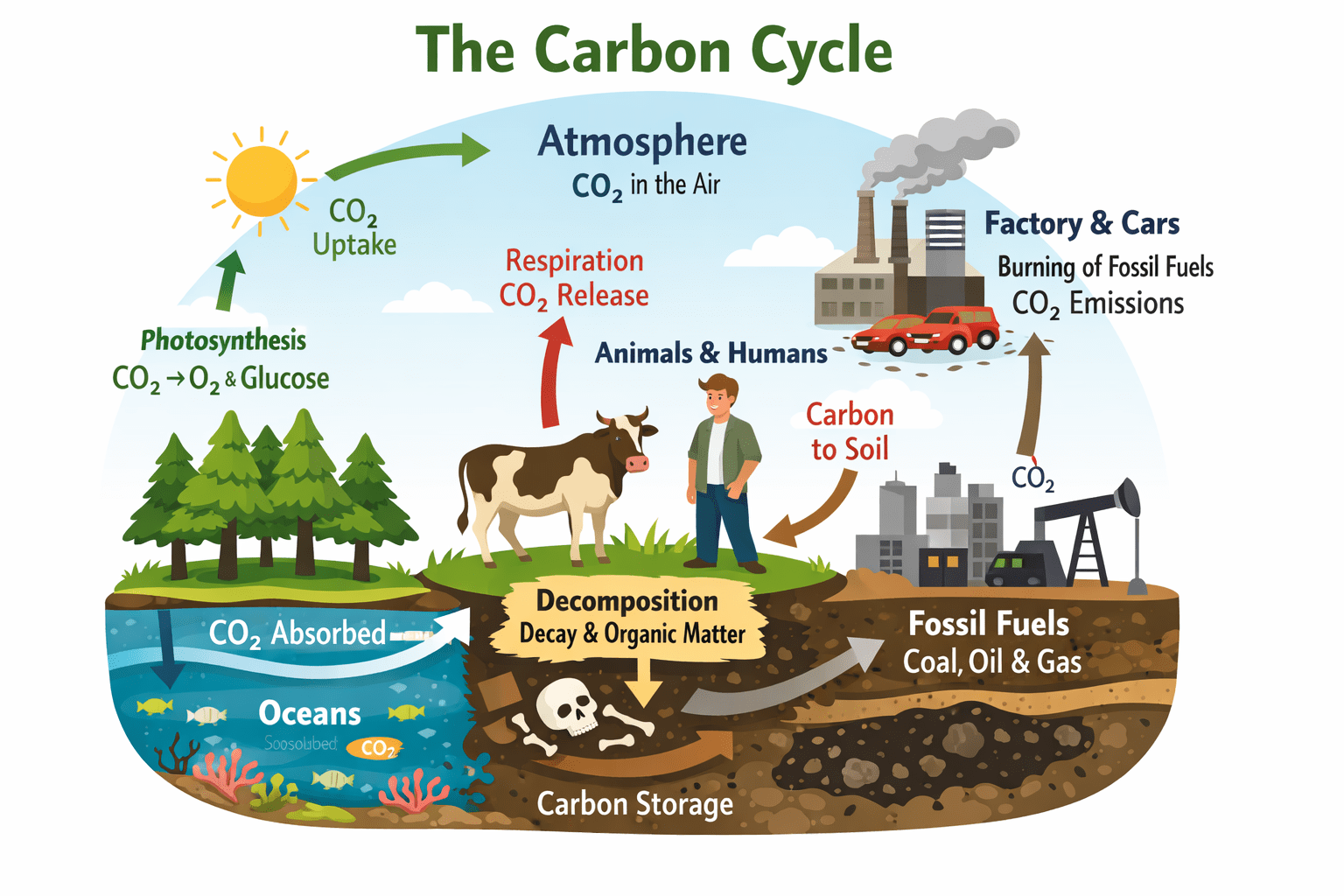
The carbon cycle involves several interconnected processes that move carbon through the biosphere, atmosphere, lithosphere, and hydrosphere. These include photosynthesis, respiration, decomposition, combustion, and carbon exchange between the oceans and the atmosphere.
- Photosynthesis
Photosynthesis is the process by which autotrophic organisms, including plants, algae, and certain bacteria, capture carbon dioxide from the atmosphere and convert it into organic compounds using light energy. In plants, CO2 from the atmosphere combines with water absorbed from the soil to produce glucose and oxygen through the general reaction:
6CO2+6H2O+light→C6H12O6+6O2
This process not only fixes carbon into a usable form but also generates oxygen, which is essential for aerobic respiration. The carbon fixed during photosynthesis forms the basis of the food web, as herbivores consume plants to obtain energy and carbon, which is then transferred to carnivores and omnivores.
- Respiration
Cellular respiration is the process by which organisms, including plants, animals, and microbes, break down organic molecules to release energy, returning carbon dioxide to the atmosphere. The reaction can be summarized as:
C6H12O6+6O2→6CO2+6H2O+energy
This process completes a critical loop in the carbon cycle, ensuring that carbon is continuously recycled between living organisms and the environment.
- Decomposition
When organisms die, decomposers such as bacteria and fungi break down their organic matter, releasing carbon back into the soil and atmosphere. Decomposition not only recycles nutrients but also ensures the continuity of the carbon cycle. Some of the carbon from decomposed organisms is converted into soil organic carbon, which may remain in the soil for years, while some is released as CO2 or methane (CH4), a potent greenhouse gas.
- Carbon in Aquatic Systems
Carbon dioxide from the atmosphere dissolves in oceans, lakes, and rivers, forming carbonic acid, bicarbonates, and carbonates. Aquatic plants and phytoplankton utilize this dissolved CO2 for photosynthesis. When aquatic organisms die, their carbon-rich bodies settle into sediments, contributing to long-term carbon storage. Over geological timescales, these sediments may form fossil fuels or carbonate rocks, representing a slow, long-term carbon reservoir.
- Combustion and Fossil Fuels
Combustion of organic matter, whether natural (wildfires) or anthropogenic (burning of fossil fuels), releases stored carbon back into the atmosphere as CO2. Fossil fuels such as coal, oil, and natural gas are derived from ancient organic matter and act as long-term carbon sinks until their combustion releases carbon rapidly, impacting the global carbon balance.
- Geological Carbon Cycling
Over millions of years, carbon is exchanged between the lithosphere and atmosphere through processes such as volcanic eruptions, weathering of rocks, and formation of carbonate minerals. These slow processes are critical for maintaining long-term climate stability but are overshadowed by rapid human-induced carbon emissions in the modern era.
Carbon Cycle and Climate Regulation
The carbon cycle plays a critical role in regulating Earth’s climate. Carbon dioxide is a greenhouse gas, meaning it traps heat in the atmosphere by absorbing long-wave radiation from the Earth’s surface. Without CO2 and other greenhouse gases, Earth’s average temperature would be far below what is necessary to sustain life. However, excessive CO2concentrations intensify the greenhouse effect, leading to global warming and climate change.
Global warming refers to the abnormal increase in the Earth’s average temperature due to the accumulation of greenhouse gases, primarily carbon dioxide, methane, and nitrous oxide. Climate change encompasses broader alterations in weather patterns, including shifts in precipitation, wind patterns, and extreme weather events. Human activities such as deforestation, industrialization, and the burning of fossil fuels have increased atmospheric CO2 levels from approximately 280 parts per million (ppm) in pre-industrial times to over 420 ppm today, significantly disrupting the natural carbon cycle.
Human Impacts on the Carbon Cycle
Human activities have dramatically altered the carbon cycle in recent centuries:
- Deforestation
Clearing forests for agriculture, urban development, or logging reduces the number of trees available to fix CO2 through photosynthesis, thereby reducing the carbon sink capacity of terrestrial ecosystems. Deforestation also contributes to soil carbon loss, further exacerbating atmospheric CO2 levels.
- Burning of Fossil Fuels
Combustion of coal, oil, and gas releases large quantities of carbon stored over millions of years, accelerating the accumulation of CO2 in the atmosphere. Transportation, energy production, and industrial processes are major contributors to this carbon influx.
- Agricultural Practices
Practices such as intensive livestock farming, rice cultivation, and use of nitrogen-based fertilizers increase emissions of methane and nitrous oxide, both potent greenhouse gases. Land-use changes also disturb soil carbon storage, further altering the carbon balance.
- Industrialization
Industrial processes, including cement production and chemical manufacturing, release CO2 and other greenhouse gases. Combined with urbanization, these processes have led to an unprecedented increase in carbon emissions over the past century.
The disruption of the carbon cycle by human activities has far-reaching consequences. Elevated CO2 levels contribute to ocean acidification, threatening marine ecosystems. Rising temperatures alter precipitation patterns, affect crop yields, and increase the frequency and intensity of extreme weather events.
Strategies for Managing the Carbon Cycle
Addressing carbon cycle disruption requires both mitigation and adaptation strategies:
- Reforestation and Afforestation
Planting trees and restoring degraded forests enhance carbon sequestration, reducing atmospheric CO2. Forest management practices that prevent deforestation are equally important.
- Renewable Energy Adoption
Transitioning to solar, wind, hydroelectric, and other renewable energy sources reduces dependence on fossil fuels, lowering carbon emissions.
- Carbon Capture and Storage (CCS)
CCS technologies capture CO2 from industrial emissions and store it underground or utilize it in products, helping reduce atmospheric carbon levels.
- Sustainable Agricultural Practices
Conservation tillage, crop rotation, and use of organic fertilizers enhance soil carbon storage and reduce greenhouse gas emissions from agricultural lands.
- Policy and Global Cooperation
International agreements such as the Paris Agreement set targets for emission reductions, promote carbon trading, and incentivize sustainable practices worldwide. Local policies, including carbon taxes and incentives for low-carbon technologies, further support carbon management.
- Public Awareness and Education
Educating communities about the carbon cycle, climate change, and sustainable living can empower individuals to adopt low-carbon lifestyles, contributing to overall carbon balance restoration.
The carbon cycle is a central pillar of life on Earth, intricately linking the biosphere, atmosphere, lithosphere, and hydrosphere. It underpins the functioning of ecosystems, regulates climate, and sustains biodiversity. However, human activities have profoundly disrupted this cycle, leading to climate change, global warming, and environmental instability. Understanding the carbon cycle in depth allows us to implement informed strategies to mitigate these impacts, restore balance, and ensure a sustainable future for generations to come.
Through targeted actions reforestation, renewable energy adoption, sustainable agriculture, and policy implementation – we can manage the carbon cycle effectively, reduce greenhouse gas emissions, and maintain Earth’s climate within safe limits. Enhancing our stewardship of the carbon cycle is not just an environmental necessity; it is a critical pathway toward sustaining life and the ecosystems that support it.
References
Abrahams P.W (2006). Soil, geography and human disease: a critical review of the importance of medical cartography. Progress in Physical Geography, 30:490-512.
Ahring B.K, Angelidaki I and Johansen K (1992). Anaerobic treatment of manure together with industrial waste. Water Sci. Technol, 30, 241–249.
Andersson L and Rydberg L (1988). Trends in nutrient and oxygen conditions within the Kattegat: effects on local nutrient supply. Estuar. Coast. Shelf Sci, 26:559–579.
Ballantyne A.P, Alden C.B, Miller J.B, Tans P.P and White J.W.C (2012). Increase in observed net carbon dioxide uptake by land and oceans during the past 50 years. Nature, 488: 70-72.
Baumgardner D.J (2012). Soil-related bacterial and fungal infections. J Am Board Fam Med, 25:734-744.
Pelczar M.J Jr, Chan E.C.S, Krieg N.R (1993). Microbiology: Concepts and Applications. McGraw-Hill, USA.
Pelczar M.J., Chan E.C.S. and Krieg N.R. (2003). Microbiology of Soil. Microbiology, 5th Edition. Tata McGraw-Hill Publishing Company Limited, New Delhi, India.
Pepper I.L and Gerba C.P (2005). Environmental Microbiology: A Laboratory Manual. Second Edition. Elsevier Academic Press, New York, USA.
Roberto P. Anitori (2012). Extremophiles: Microbiology and Biotechnology. First edition. Caister Academic Press, Norfolk, England.
Salyers A.A and Whitt D.D (2001). Microbiology: diversity, disease, and the environment. Fitzgerald Science Press Inc. Maryland, USA.
Discover more from Microbiology Class
Subscribe to get the latest posts sent to your email.